 CloudRadial
MSP Request Forms that Produce Complete Tickets, Not Follow-Up Emails
Every MSP has a ticket that reads "new hire starting Tuesday, needs a laptop." It's not wrong. It's just not finished.




Enterprise-grade infrastructure with the flexibility MSPs demand

Perfectly tailored AI that knows your specific MSP

Build your own Shopify-like store with your PSA products & distributors

Have clients to submit tickets directly to your PSA, freeing up your team's time

Pre-triage and route tickets correctly with the help of AI

Everything you need to start automating, no code required.
When the economy softens, the first thing that happens inside your clients' businesses is not a cancellation. It's a spreadsheet. Someone in finance opens the vendor list and starts asking, line by line, a single question: what are we actually getting for this?
That question is where managed-services relationships are won or lost in a downturn. Not on the quality of your work, which has probably never been better, but on whether the client can see it. The uncomfortable truth of this industry is that most of what an MSP does is invisible by design. The patches that installed cleanly, the phishing attempt that never reached an inbox, the backup that ran at 2 a.m. and worked: when everything goes right, the client experiences nothing. And nothing is very hard to justify on a spreadsheet.
This is why, when money gets tight, your client portal stops being a convenience and becomes a retention instrument. It is the one place where invisible work becomes visible at the exact moment a client is deciding whether you're worth keeping.
You already know the shape of the economics, so we won't dress it up: keeping an existing client costs a fraction of winning a new one, and a client who renews in a downturn tends to keep renewing on the other side of it. The hard part isn't understanding that. The hard part is that a downturn compresses your two options at once. Your clients are scrutinizing spend, and your own margins are under the same pressure, so you can't simply out-service the problem by throwing hours at every account.
What you can do is change what the client sees when they go looking for reasons to cut. A renewal conversation during good times is a formality. A renewal conversation during a downturn is a defense, and you want to walk into it holding evidence rather than adjectives. The portal is where that evidence lives.
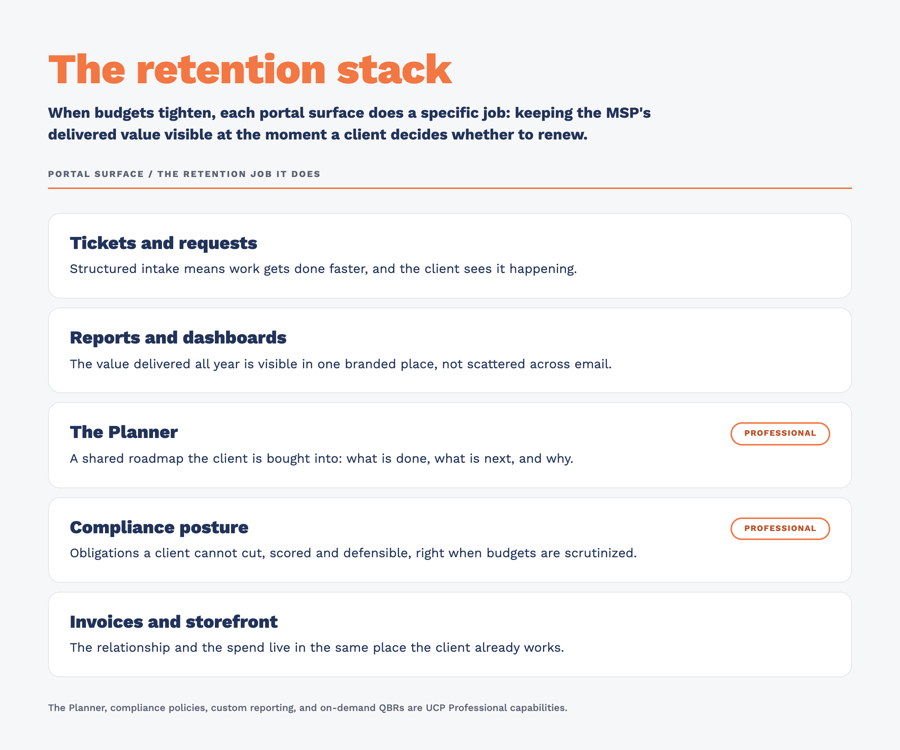
Consider what a client actually has, right now, if you don't give them a portal. Their tickets live in your PSA, which they rarely log into. Their reports arrive as email attachments they've long since stopped opening. Their invoices are in a third place. Their compliance posture, if they think about it at all, is a vague sense that "IT is handled." None of that survives contact with a cost-cutting review, because none of it is in front of the person doing the cutting.
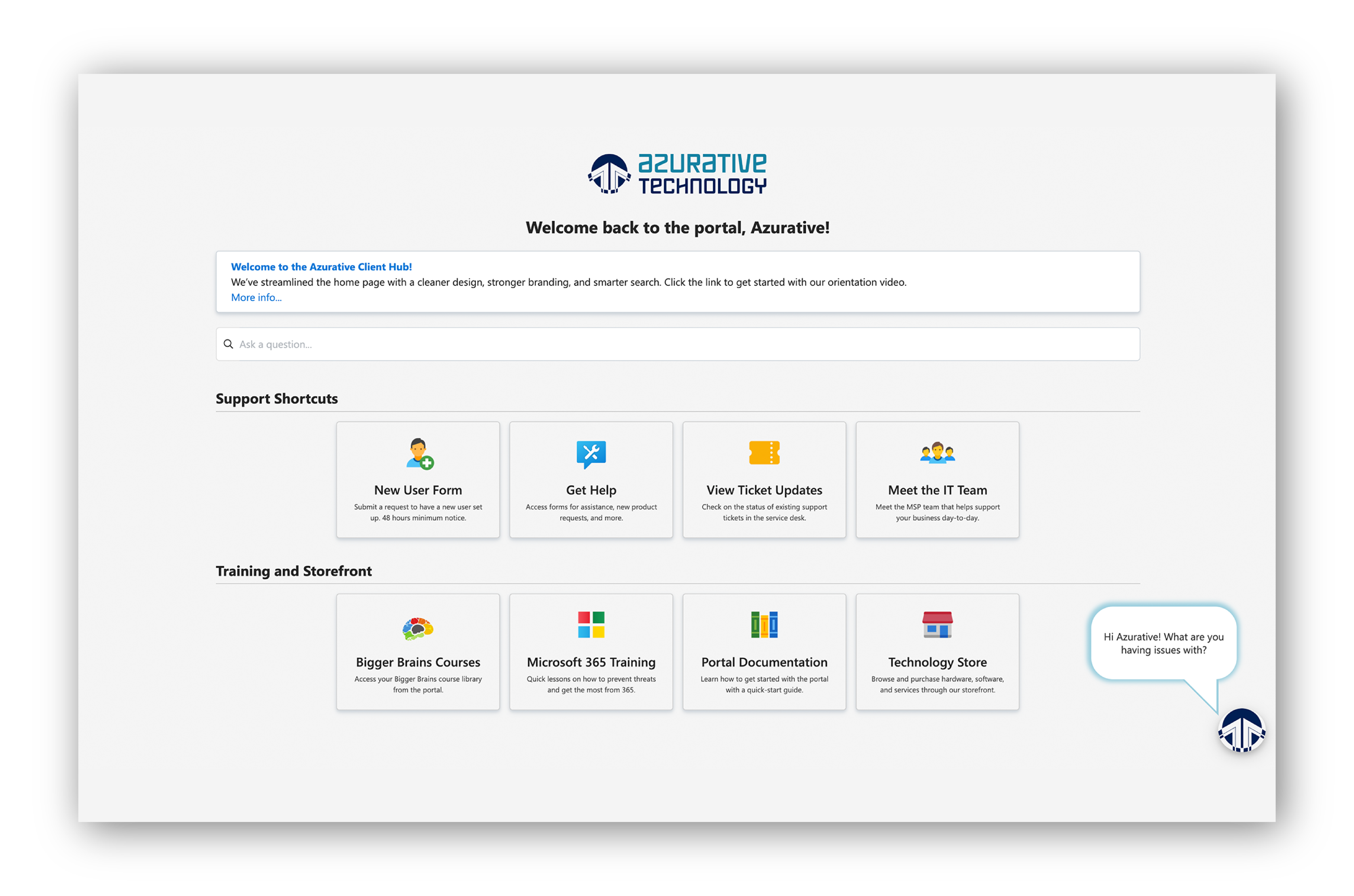
A client portal collects the entire relationship into one branded surface: open and closed tickets, the reports you generate, invoices, compliance posture, the knowledge base, and the catalog of things the client can request. For the Client Admin, the person at the client who handles tech and who is very often the one being asked to justify the spend, this is the difference between "IT is a line item I can't evaluate" and "here is everything my MSP does, in one place, with my logo on it."
That's the core mechanism, and everything else in this article is a variation on it. Making delivered value continuously visible is what turns a portal from a support tool into a reason to stay.
See what a portal built to make your value visible looks like: explore the CloudRadial Unified Client Portal.
If the portal is where value becomes visible day to day, the quarterly business review is where you make the argument out loud, and a downturn raises the stakes on every QBR you run.
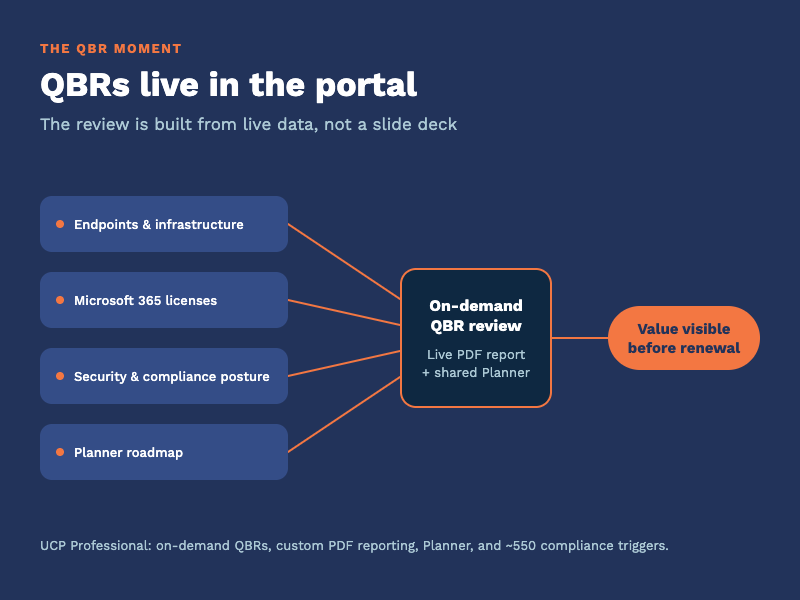
Done badly, a QBR is a slide deck someone assembled at midnight, full of screenshots that are already stale. Done well, it's a working review anchored in live data the client can see for themselves. This is where the reporting and planning side of a mature portal earns its keep. On CloudRadial's UCP, the Planner gives you a shared roadmap with the Client Admin, a single Kanban view of what's been done, what's underway, and what's coming next, so the QBR stops being a report-out and becomes a plan the client is bought into. Pair that with on-demand reporting that pulls live endpoint, license, and security data, and QBR prep drops from a days-long scramble to something you can generate when you need it.
The retention logic here is direct. A client who has sat through a data-backed review of what you've delivered, and helped shape the roadmap of what's next, has a much harder time treating you as an interchangeable line item three months later. They've seen the value, and they've participated in the plan. If you want to see how MSPs are scaling this without burning a week per quarter, CloudRadial's on-demand QBR approach is built specifically for this problem, and the vCIO Account Planner is the surface that carries the roadmap.
There's a particular kind of leverage in a downturn that most MSPs underuse: obligations the client cannot walk away from no matter how tight the budget gets. Cyber-insurance requirements, regulatory frameworks, and security baselines don't relax because the economy did. If anything, they get more scrutiny, because a breach during a lean year is existential.
A portal that scores and displays compliance posture turns that obligation into a visible, defensible artifact. When posture is continuously evaluated against a defined standard and surfaced where the Client Admin can read it, "are we compliant?" stops being a source of anxiety and becomes a dashboard. CloudRadial UCP's compliance library covers roughly 550 partner-customizable triggers across endpoint, license, and tenant data, giving the client an at-a-glance picture of where they stand and giving you a value story that's almost impossible to argue with at renewal. You're not defending a nice-to-have. You're the reason an unavoidable obligation is under control.
There's a version of the "sticky portal" argument that's really just a lock-in argument in nicer clothes, and it's worth being honest that it doesn't hold up. You don't retain clients by trapping them. You retain them by becoming genuinely woven into how their business runs, so that leaving would mean giving up something they actually use.
Here's what that looks like in practice. We recently watched one MSP drive portal adoption across its client base so effectively that they outgrew their user tier and had to upgrade, simply because the portal had become the working surface their clients' teams relied on. Read that carefully: the MSP didn't hit a limit because of a pricing trick. They hit it because the thing they'd built was being used. That's what earned embeddedness looks like, and it's the strongest retention position there is, because it isn't a contract clause. It's a habit.
The way you get there is not by hoping clients will love logging in. It's by making the portal the place where the real work happens: where requests get submitted and approved, where documentation lives, where procurement runs. When the relationship genuinely runs through the portal, switching away isn't a matter of disliking you. It's a matter of ripping out infrastructure, and clients under budget pressure have no appetite for that kind of disruption.
The last piece of the downturn puzzle is the one that's easy to forget: the squeeze is on you too. Retention doesn't just depend on the client seeing value. It depends on the service not quietly degrading while you try to hold margins, because slow decline in service quality is what actually drives churn, even when nobody can name the moment they decided to leave.
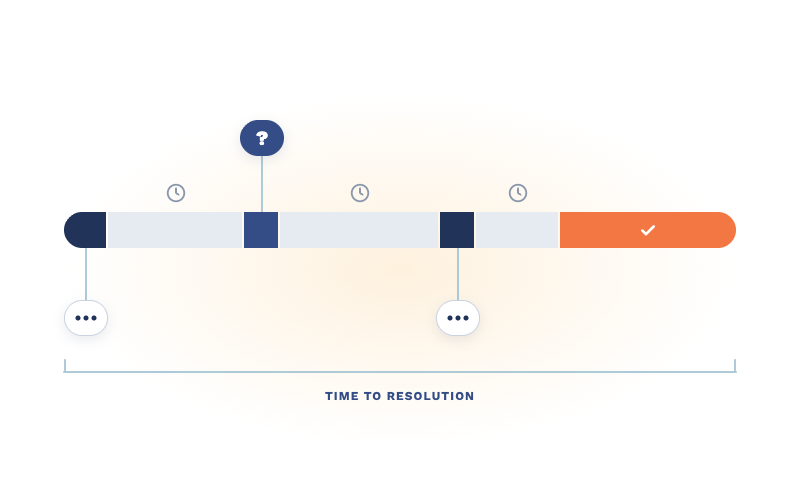
This is where structured intake does real work. When requests come in through configurable forms with conditional logic, attachments, and approval routing, they arrive in your PSA already structured, so a tech can start working instead of chasing basics. The ticket is sacred here: the goal is never to deflect requests or push clients away from asking, it's to make every request that comes in better-formed so your team resolves it faster. That lets you hold service quality steady without adding headcount you can't afford, which is exactly the trick a downturn demands. One Syntech Group partner, mid-implementation, put it plainly when they saw the forms replace a tool their team had been fighting with: "the person who makes our forms is going to love you." Faster, cleaner intake protects the relationship precisely when your capacity to over-serve is at its thinnest.
The retention case gets stronger, not weaker, as a client's own operating model grows up. What starts as a place to log tickets becomes, over time, the surface a client plans their IT around, and a portal that keeps pace with that shift is one a client has less and less reason to leave.
You can see the pattern in how clients respond as they move up the maturity curve. One Nellcom CTO, re-engaging with the platform around a vCIO model, pointed straight at the Planner and said "that is actually exactly what we're looking for." That's the tell: the client isn't reacting to a feature demo, they're recognizing the portal as the answer to a need they've just grown into. When the portal is already the place the roadmap lives, the compliance posture is scored, and the reporting is generated, a maturing client doesn't go shopping for a new tool. The one they have grew with them.
The through-line is the same one that runs through everything above. The portal is where your value stops being something the client takes on faith and becomes something they can see, use, and plan around, and that only compounds the longer the relationship lasts.
A downturn doesn't change how good your work is. It changes how visible it has to be. When every invoice is under review, the MSPs who retain clients are the ones whose value is impossible to miss, because it's collected in one branded place the client already works in, backed by reviews the client helped shape and obligations the client can't afford to drop.
That's not a feature. It's a retention strategy, and the portal is the engine that runs it.
See how CloudRadial's Unified Client Portal makes your value impossible to overlook at renewal. Book a demo.
How does a client portal actually improve client retention?
A client portal improves retention by making an MSP's delivered value continuously visible in one place, which matters most when clients are scrutinizing every expense. Instead of tickets, reports, invoices, and compliance data being scattered across email and separate tools, the portal collects them into a single branded surface the Client Admin can see and use. CloudRadial's Unified Client Portal is built around this principle: it's the relationship surface where an MSP's work becomes visible, so the value is obvious at renewal rather than taken on faith.
Why does client retention matter more during an economic downturn?
During a downturn, clients audit their spending and question every vendor relationship, so the risk of churn rises even for MSPs delivering excellent work, because much of that work is invisible by nature. Keeping an existing client is also far more cost-effective than acquiring a new one, which makes retention the higher-leverage investment when budgets are tight. A portal that keeps delivered value visible directly addresses the "what am I paying for" question that drives cancellation decisions. CloudRadial UCP is designed to surface exactly that value.
What portal features have the biggest impact on retention?
The features with the biggest retention impact are the ones that make value visible and the relationship harder to replace: consolidated reporting and dashboards, a shared roadmap for planning, compliance scoring, and structured request intake. In CloudRadial UCP, the Planner gives the MSP and Client Admin a shared roadmap, on-demand QBR reporting turns account reviews into a repeatable motion, and a compliance library of roughly 550 customizable triggers makes posture defensible. The Planner, compliance policies, and on-demand QBRs are available on UCP Professional.
Can a client portal help with quarterly business reviews?
Yes. A client portal can transform the QBR from a manually assembled slide deck into a working review anchored in live data, which both saves preparation time and makes the review more persuasive. When the QBR is built on data the client can see and a roadmap the client helped shape, it does far more to secure the next renewal than a static report. CloudRadial UCP runs QBRs on live endpoint, license, and security data with a shared Planner, so reviews are generated on demand rather than rebuilt from scratch each quarter (a UCP Professional capability).
Isn't a "sticky" portal just vendor lock-in?
No. Retention through a portal comes from genuine embeddedness, not contractual lock-in: the client stays because the portal is where their team actually works, not because leaving is artificially difficult. That distinction matters, because trapped clients churn the moment they can, while embedded clients renew because switching would mean giving up infrastructure they rely on. CloudRadial UCP earns that position by becoming the place requests, approvals, reporting, and procurement genuinely run through, which is a habit rather than a handcuff.
Every MSP has a ticket that reads "new hire starting Tuesday, needs a laptop." It's not wrong. It's just not finished.
Every quarter you sit across from a client and answer one question, spoken or not: what are we paying you for? The quarterly business review is where...
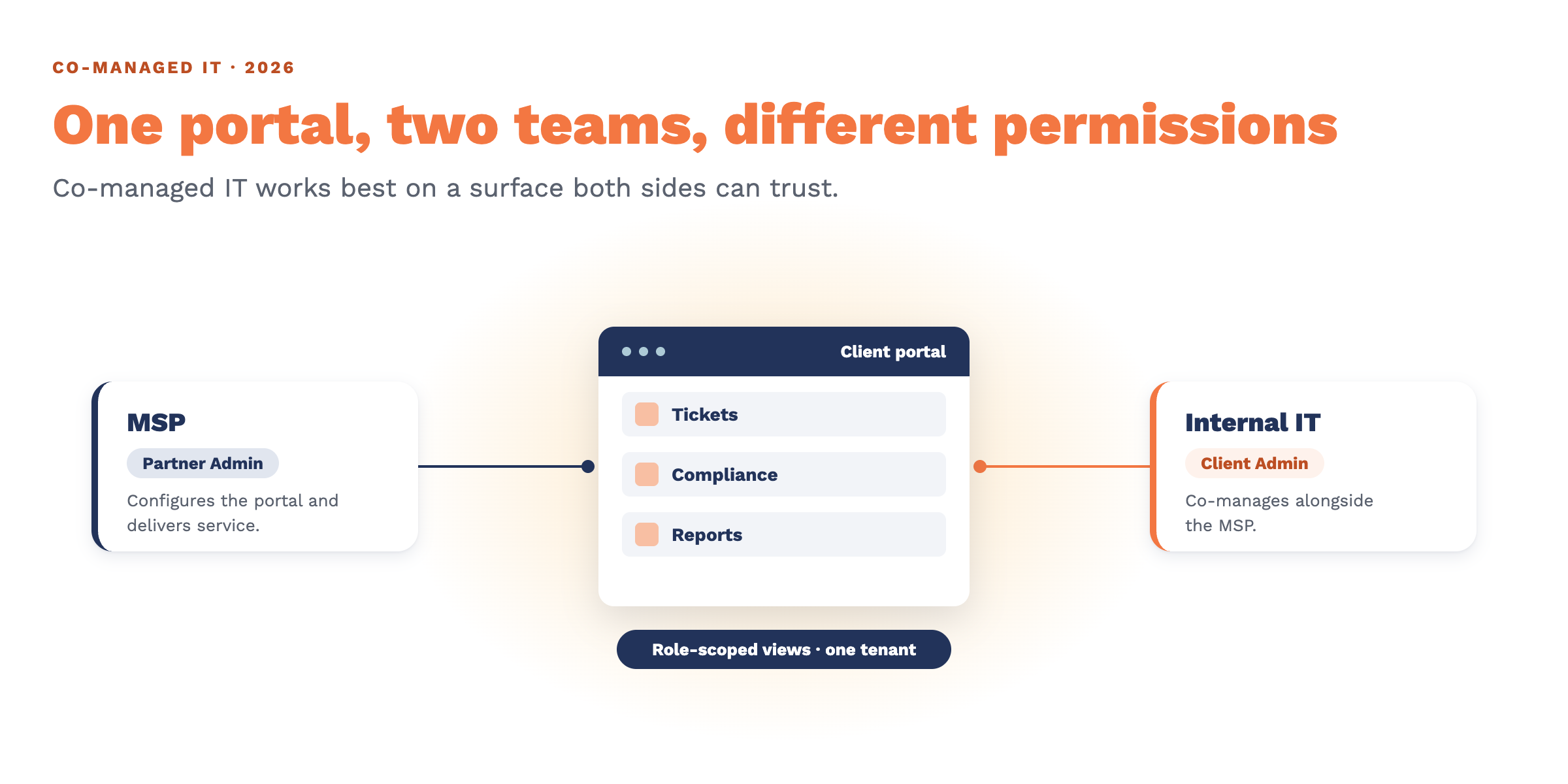
Co-managed IT is one of the fastest-growing shapes an MSP relationship can take, and it breaks a quiet assumption most service desks are built on:...