 CloudRadial
The MSP QBR is a Reporting Problem, Not a Meeting Problem
Every quarter you sit across from a client and answer one question, spoken or not: what are we paying you for? The quarterly business review is where...




Enterprise-grade infrastructure with the flexibility MSPs demand

Perfectly tailored AI that knows your specific MSP

Build your own Shopify-like store with your PSA products & distributors

Have clients to submit tickets directly to your PSA, freeing up your team's time

Pre-triage and route tickets correctly with the help of AI

Everything you need to start automating, no code required.
Every quarter you sit across from a client and answer one question, spoken or not: what are we paying you for? The quarterly business review is where that gets decided. It is also where a lot of good MSP work goes to die, because the evidence is scattered.
Tickets sit in the PSA. License counts live in Microsoft 365. Security posture is in one tool, backups in another, the roadmap in someone's head or a spreadsheet the client never opens.
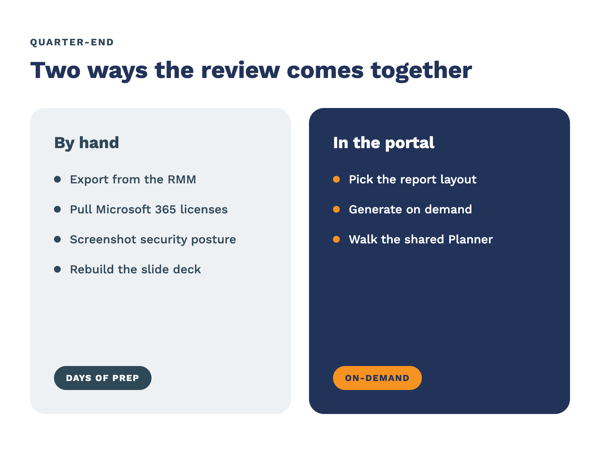
So the review becomes a scramble. Someone exports from the RMM, pulls the license report, screenshots a dashboard, and rebuilds the deck from scratch. By the time it is ready, two things have happened: you have burned hours you cannot bill, and the story you tell is a snapshot instead of the whole quarter.
It is prep time you cannot bill, repeated for every client, every quarter. The report gets assembled by hand, late, from sources that do not talk to each other.
You reach the exact moment renewal is on the table with a thin value story. The work you did all year (the incidents you caught before anyone noticed, the patches, the access reviews) is the work the client never sees. Capability only creates value the client can act on if the client can see it. An invisible save is, to the person signing the renewal, no save at all.
Here is the shift worth making: the QBR is a reporting problem, not a meeting problem. The meeting is fine. What breaks is that the report gets assembled by hand, late, from sources that do not talk to each other. Fix the reporting and the meeting takes care of itself.
A good quarterly review has three properties.
It reflects this quarter, not a stale export. The numbers are current because they are pulled, not rebuilt.
Prep is a pull rather than a project. The report generates on a repeatable layout instead of coming together from scratch each cycle.
The client has been seeing the work all along, so the review confirms a story they already believe instead of making the case from zero.
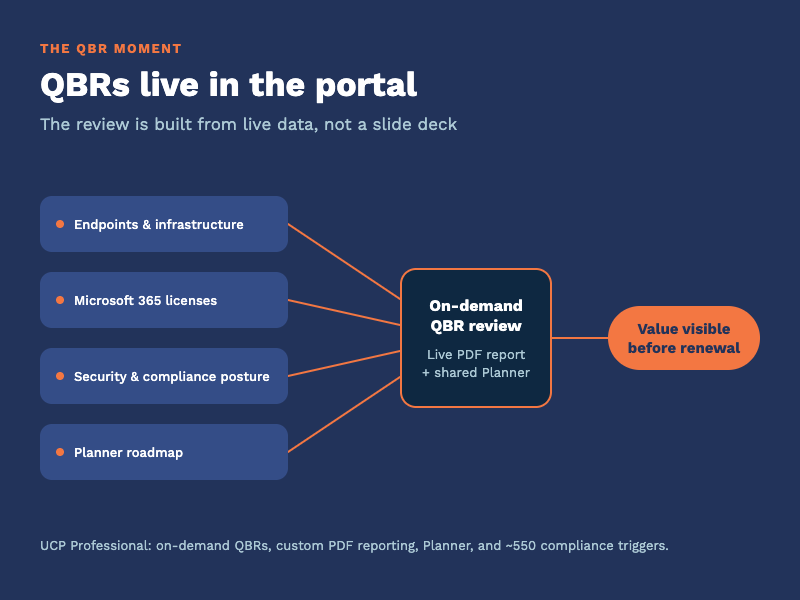
In practice that means pulling endpoint, license, and security data into a report you generate rather than rebuild. It means a compliance posture scored against a standard, so "are we secure?" has an answer on the screen. And it means a shared roadmap, a planner the client can open any day, that shows what is going right, what is going wrong, and what you are doing about it. The review stops being a performance and becomes a checkpoint on a story the client has been watching.
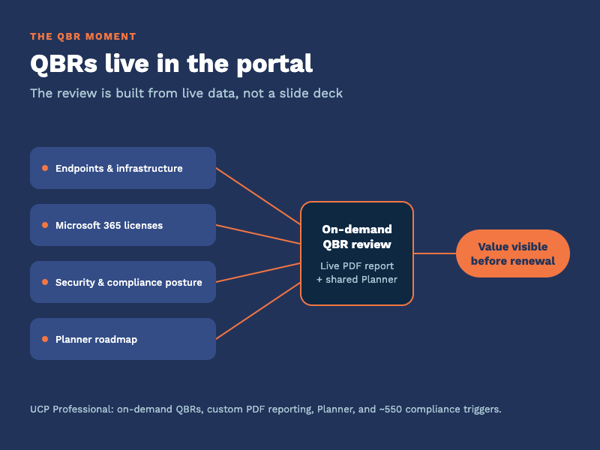
This is the job CloudRadial's Unified Client Portal is built for. It pulls endpoint, license, security, and tenant data through a read-only agent and your existing RMM and Microsoft 365 integrations, and turns it into on-demand PDF reviews.
Its Planner gives you a shared Kanban the client sees, a natural QBR anchor. Compliance posture scores against roughly 550 partner-customizable triggers. On-demand QBRs, custom PDF reporting, the Planner, and that compliance scoring are UCP Professional capabilities, so size the tier to the clients you run reviews for. None of it replaces your PSA or RMM: it reflects their state back to the client in one branded place they already work.
See how an on-demand QBR comes together inside the portal at cloudradial.com/qbr, or book a walkthrough and we will run one against a live tenant: Schedule a demo.
At minimum: service and ticket trends, security and compliance posture, asset and license inventory, and a forward-looking roadmap tied to the client's business goals. Reviews that land lead with outcomes, risk reduced and work completed, rather than raw activity counts.
Quarterly is the default, hence the name, but the cadence that matters is continuous visibility between meetings. A client who can see the work all quarter gets more from the review than one who sees it once every ninety days.
Stop rebuilding the report by hand. Generate it from live data on a repeatable layout so prep is a generate step, not a research project. You can see how that works inside the portal at cloudradial.com/qbr.
Every quarter you sit across from a client and answer one question, spoken or not: what are we paying you for? The quarterly business review is where...
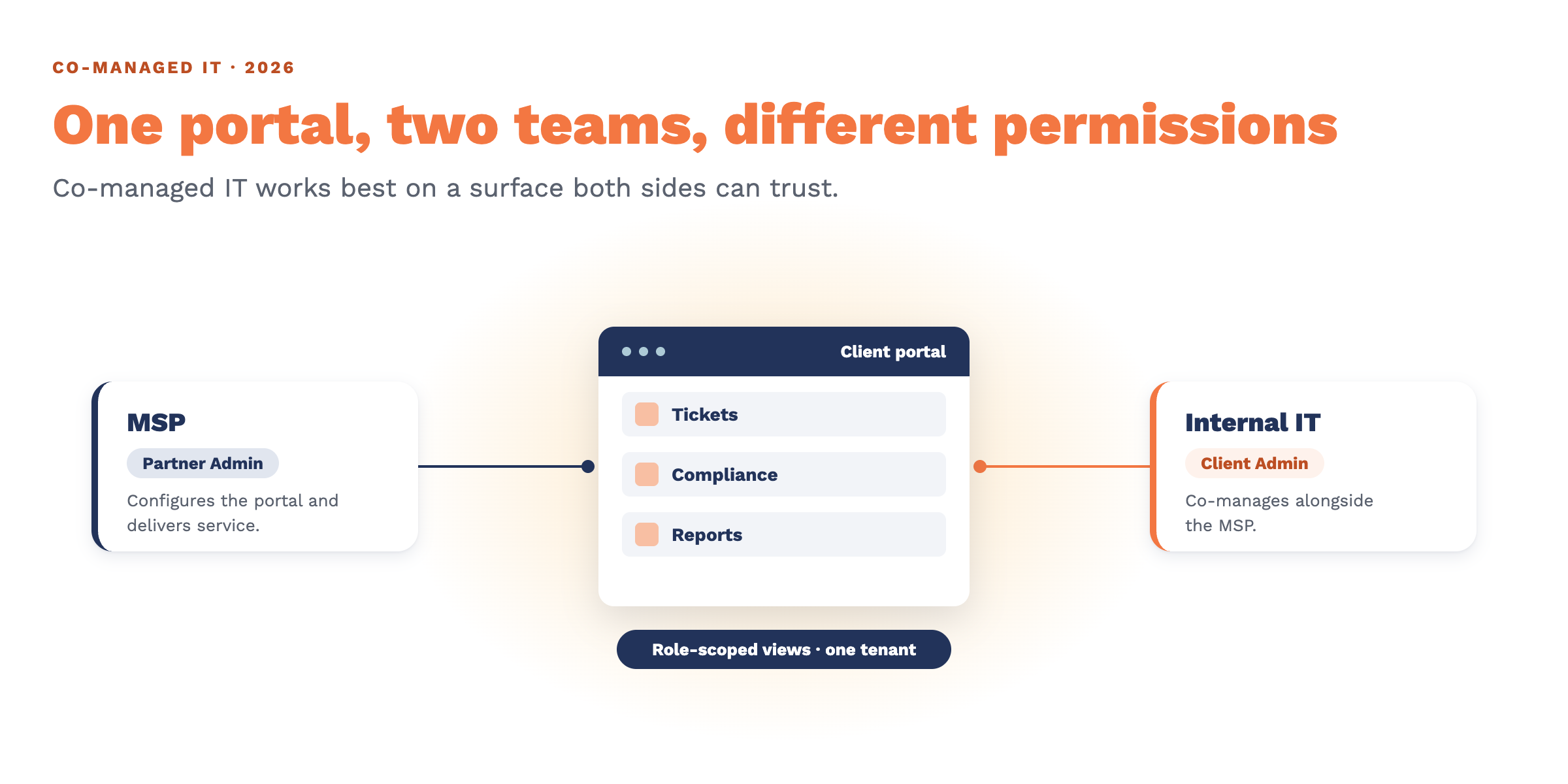
Co-managed IT is one of the fastest-growing shapes an MSP relationship can take, and it breaks a quiet assumption most service desks are built on:...
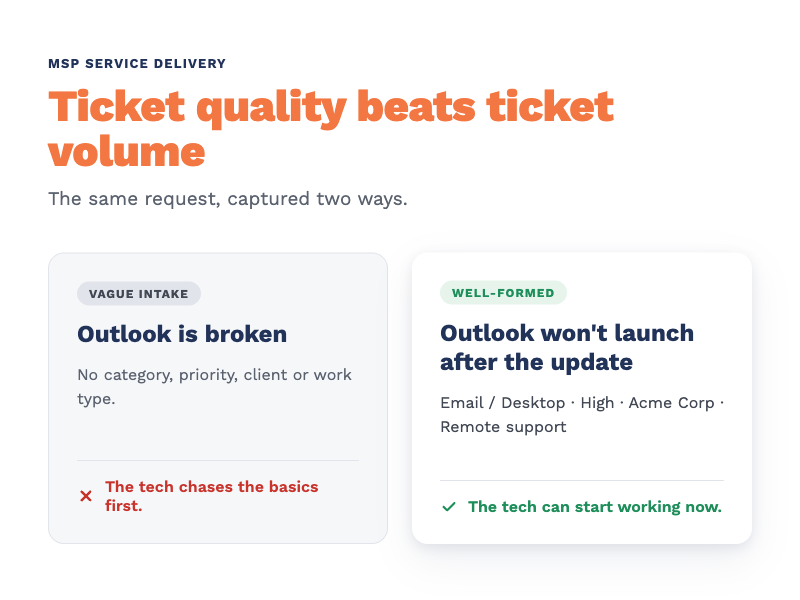
Most service desks track ticket volume, because it is the easy number: it sits on the dashboard and it moves. But volume only tells you how much...