 CloudRadial
Where's My Ticket? How MSPs Answer the Status Question Before Clients Ask
You know the email. "Any update on this?" Four words, and it lands in the inbox of whoever is nearest the service desk.




Enterprise-grade infrastructure with the flexibility MSPs demand

Perfectly tailored AI that knows your specific MSP

Build your own Shopify-like store with your PSA products & distributors

Have clients to submit tickets directly to your PSA, freeing up your team's time

Pre-triage and route tickets correctly with the help of AI

Everything you need to start automating, no code required.
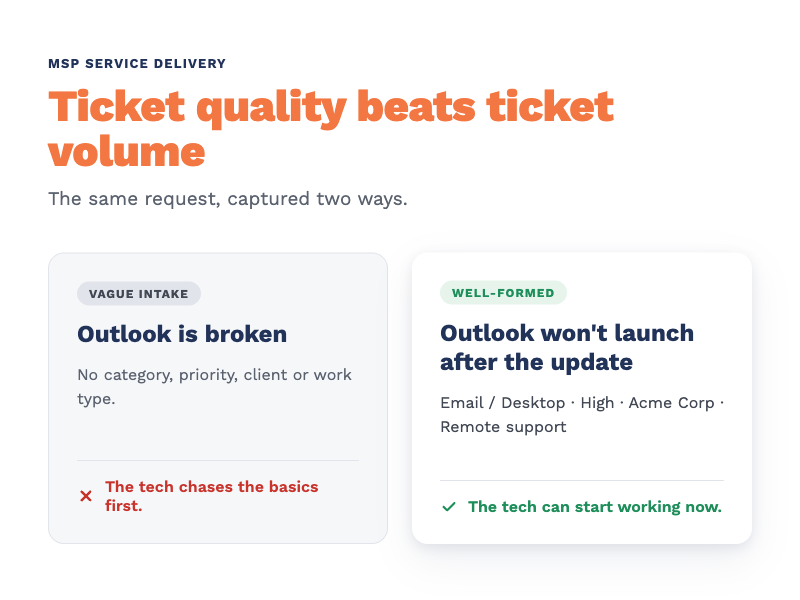
Most service desks track ticket volume, because it is the easy number: it sits on the dashboard and it moves. But volume only tells you how much traffic hit the desk. It says nothing about whether any single ticket was captured well enough to bill it, meet an SLA on it, report it honestly, or reuse what you learned solving it. The number that predicts those outcomes is not how many tickets you received. It is how good they are.
The short answer: the metric worth tracking is ticket quality. A high-quality ticket has the right category and type, routes to the right board and technician, carries enough detail for work to start without a round of clarifying questions, and ends with a clean resolution record. Get that right and your SLAs, your billing, your reporting, and your documentation all get better at the same time. This article covers what a well-formed ticket is worth, where its quality is won, and how AI sharpens it without ever removing the ticket itself.
Ticket volume is a traffic count, and traffic counts mislead in both directions. A rising number can mean more captured work or just more noise. A falling number can mean real efficiency or it can mean requests never made it into the system in the first place, which is the most expensive kind of "improvement" there is, because you pay for that missing work later in escalations, missed SLAs, and a client who feels unheard.
Quality is a better scoreboard because it maps to the things you actually get paid for. So the question to put in front of your team is not "how many tickets did we get this month?" It is "how many of our tickets were good enough to work, bill, and learn from on the first pass?"
This is also, quietly, a philosophical stance. The goal is not to make the ticket disappear. The ticket is the unit of measurable work for an MSP: it is what your SLAs, your invoices, your reports, and your accountability all rest on. The job is to make creating one effortless and to make the result genuinely useful.
A good ticket is not tidiness for its own sake. It pays off four ways, and each one touches revenue or retention.
SLAs. An SLA clock is only meaningful if the ticket is scoped and categorized correctly. A misrouted or mis-typed ticket can breach its target before a technician ever opens it, and no amount of fast work afterward undoes that.
Billing. Work type, billable time, and budgeted hours are the fields that turn effort into an invoice. A ticket that is missing them is work you performed but cannot cleanly bill, which is margin leaking straight out of the desk.
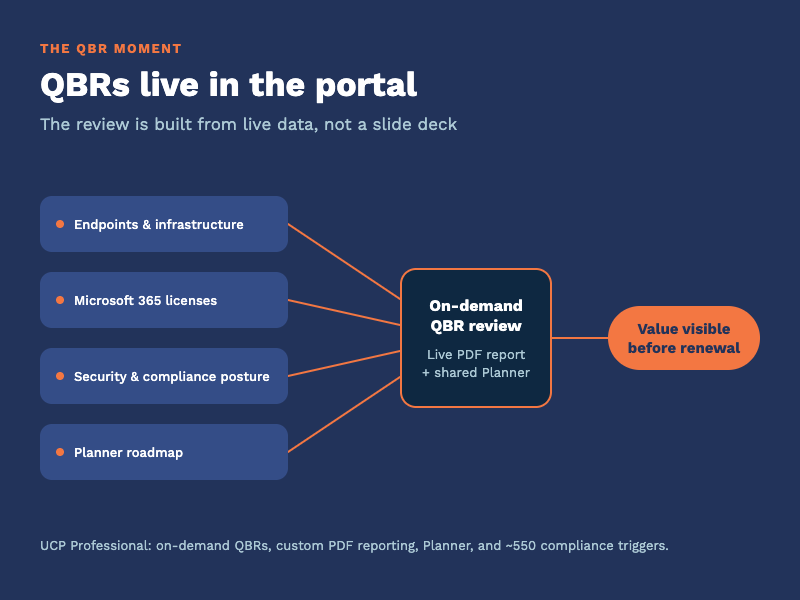
Reporting and QBRs. Reports are only as honest as the tickets beneath them. When the underlying records are clean, a quarterly business review becomes a defensible story about the value you delivered rather than a scramble to reconcile the data. On-demand QBR and custom reporting sit in UCP Professional, and they are only as strong as the ticket quality feeding them.
Reuse. A vague ticket teaches no one. A well-documented one is reusable knowledge the next technician, and the next client, both benefit from. More on that below, because it turns out to be the biggest opportunity of the four.
Most quality problems are set at the moment of capture, not at resolution. If a request enters the system as "it's broken," every later step inherits that ambiguity.
And the ambiguity is common: CloudRadial's own product data shows that roughly one in four end users cannot reliably tell the difference between "Report a Problem" and "Request Service." If a quarter of your users cannot classify their own request, the ticket starts life pointed in the wrong direction.
Two things fix this at the source.
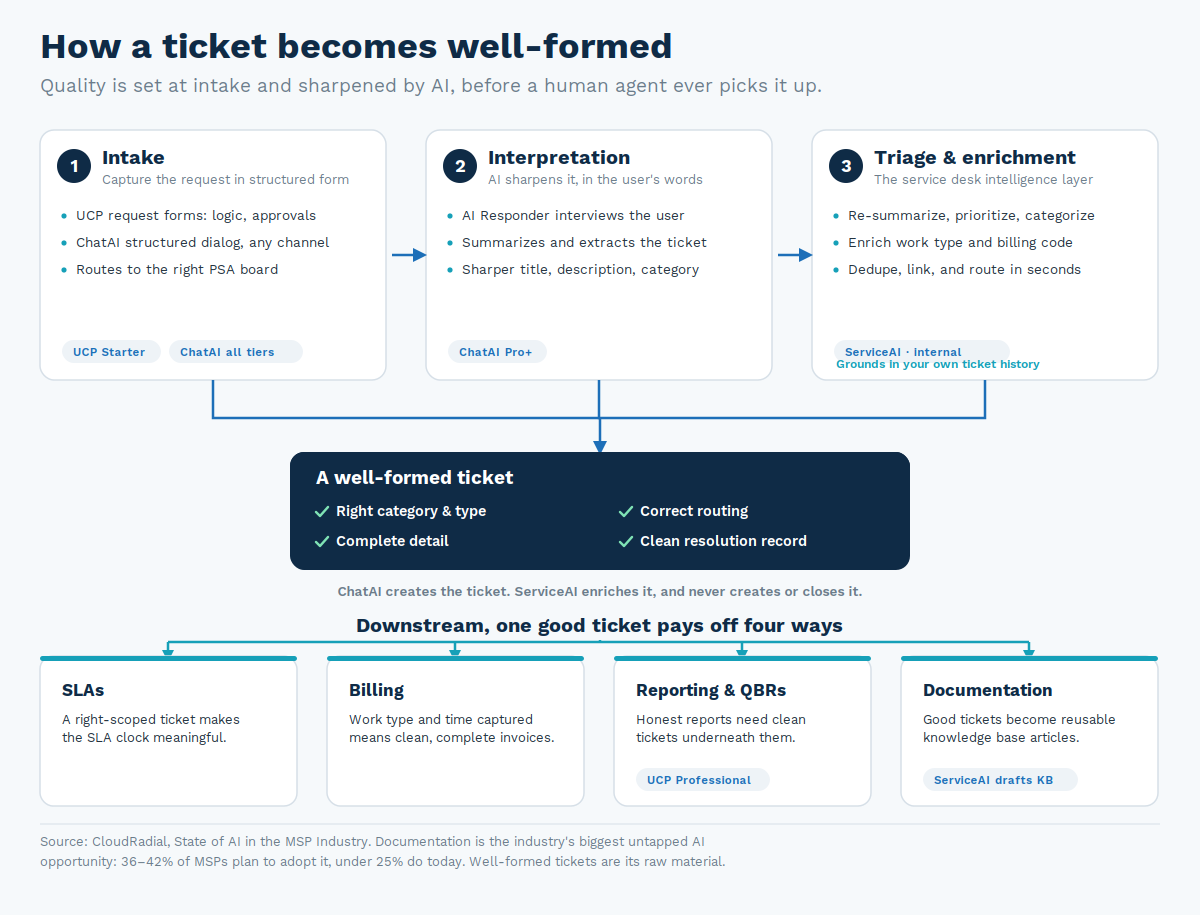
The first is structured self-service intake. UCP request forms use conditional logic, attachments, and single or multi-level approvals, and they route each submission straight to the correct PSA board, status, and type through the API rather than through an inbox. The request arrives already structured, so a technician can start working instead of chasing the basics. Onboarding and offboarding are the classic example: a form that asks the right questions up front produces a ticket a technician can act on, while an email that says "new hire Tuesday" produces a week of back-and-forth. Request forms and approvals are available on UCP Starter, so this is not a premium-tier luxury. (For a closer look at how structured request forms shape intake, see the service catalog.)
The second is structured conversation. ChatAI runs a deterministic dialog in the channels your clients already use, and it captures the specifics up front. That produces a more complete ticket than an email that lands half-empty, and it skips the hold time of a phone call that leaves nothing in writing. Every conversation still becomes a ticket in the PSA; the win is a better ticket, reliably captured, not a smaller count of them.
Once a request is being captured, AI can raise its quality further at two distinct points.
Interpretation, at the front door. On ChatAI Pro and above, the AI Responder interviews the end user in their own words, asks the interview-style follow-ups a good dispatcher would, summarizes the exchange, and extracts a clean ticket from it: a sharper title, a structured description, and the right category, all before a human agent engages. Chat Starter is the structured dialog on its own, without the AI layer, so it still captures a complete ticket; the AI Responder is what makes the resulting ticket sharper.
Triage and enrichment, inside the desk. ServiceAI is the service desk's internal intelligence layer. Once a ticket exists in the PSA, ServiceAI re-summarizes it, sets priority, categorizes it, enriches the fields that matter downstream such as work type and billing code, detects duplicates and spam, links related tickets, and routes or assigns it, typically in seconds. It grounds every judgment in your own ticket history and documentation, so its decisions reflect how your team has actually solved problems, and your data stays in your own tenant. Two boundaries are worth stating plainly, because they are what keep the model honest: ServiceAI works on tickets that already exist, so it does not create them, and it enriches and routes rather than closing or resolving them on its own. The technician stays in control; they simply start from a better position.
Put together, the effect is compounding. Intake gives you a structured request, interpretation sharpens it in the user's language, and triage enriches and routes it. The output is a ticket that is genuinely ready to work.
Take the next step: If you are mapping where AI belongs across your service desk, the MSP Roadmap to AI-Powered Service Delivery lays out the stages in order, from structured intake through triage, so you can sequence the work instead of guessing at it.
Here is where ticket quality stops being an operations metric and becomes a competitive one. Every well-formed ticket is a small deposit into your institutional knowledge. ServiceAI can draft knowledge base articles from resolved tickets for review and save-back, which means the desk's own work becomes durable, searchable documentation instead of evaporating the moment the ticket closes.
That matters more than it might sound, because documentation is the single biggest untapped opportunity in the market right now. In CloudRadial's State of AI in the MSP Industry report, every documentation use case shows strong future intent (36 to 42 percent of MSPs plan to adopt it) against low current adoption (under 25 percent do today). The report's read on the gap is blunt: the first movers here are not just saving time, they are building institutional knowledge their competitors cannot replicate.
You cannot build that knowledge on vague tickets. Documentation is downstream of ticket quality, which makes ticket quality upstream of the market's number-one AI opportunity. It is also a reminder that the easy AI wins are already table stakes: if your AI footprint is writing emails and summarizing meetings, you are at parity, not ahead. The durable lead comes from applying AI where the ticket is formed. And the risk calculation has clearly shifted, with fewer than one in ten MSPs now seeing no role for AI in the outcomes they care about, service quality among them.
Ticket volume measures how busy you were. Ticket quality measures whether the work was captured well enough to bill it, meet SLAs on it, report it honestly, and reuse it. Structured intake sets that quality, AI interpretation and triage sharpen it, and good documentation compounds it. Track the number that actually predicts your margins and your renewals, and build the desk that produces it.
See it on your own service desk. Book a demo to walk through structured intake, AI-assisted triage, and the reporting that a clean ticket makes possible.
Should MSPs try to reduce ticket volume?
Volume is the wrong target. A lower count can reflect genuine efficiency, or it can mean requests never reached you, which costs you later. Track ticket quality instead: whether each ticket is complete, correctly categorized, and routed so work can start on the first pass.
What actually makes a ticket "good"?
Four things: the right category and type, correct routing to the right board and technician, enough detail to begin work without a clarifying round, and a clean resolution record with the billing and work-type fields filled in. Those are the attributes that make the ticket useful for SLAs, invoicing, and reporting.
Does self-service mean fewer tickets?
No. Self-service intake is about better-formed tickets and faster help, not a smaller number. Every request still becomes a ticket in the PSA; structured forms and structured chat simply make that ticket more complete when it arrives.
Where does AI fit without replacing technicians?
AI works at intake and triage, not at the technician's chair. On ChatAI Pro and above, the AI Responder interviews the user and drafts a sharper ticket; ServiceAI then enriches and routes it internally, grounded in your own ticket history. Every conversation still produces work for a human, who starts from a better position rather than a blank one.
@2x.png)
You know the email. "Any update on this?" Four words, and it lands in the inbox of whoever is nearest the service desk.
Every MSP has a ticket that reads "new hire starting Tuesday, needs a laptop." It's not wrong. It's just not finished.
Every quarter you sit across from a client and answer one question, spoken or not: what are we paying you for? The quarterly business review is where...