Your service desk manager pulls up the dashboard and smiles. Response times are faster. More tickets handled per technician. Documentation time reduced.
"The AI is working," they announce in the leadership meeting.
Except... maybe it's not. Not in the way that matters.
Three months later, you're still drowning in tickets. Clients aren't noticeably happier. Your team is busier than ever. You've gotten faster at doing the same work, but fundamentally nothing has changed.
That's because you're measuring productivity when you should be measuring transformation readiness.
And there's a massive difference between the two.
Why Productivity Metrics Lie About AI Success
Productivity metrics are easy to measure: response times, tickets resolved per day, documentation speed, time to resolution.
They're familiar. Your PSA tracks them automatically. Leadership understands them. They provide clear before-and-after comparisons.
They're also completely insufficient for measuring AI transformation potential.
Here's why: productivity metrics measure efficiency at doing the same work. Transformation metrics measure whether you're building the foundation for fundamentally different work.
Let's say you implement AI suggestions, and your techs start using AI-generated responses for password resets, cutting time from 5 minutes to 2 minutes. Productivity improves. Success, right?
Not quite. You're still having your expensive technicians handle routine password resets. You're just having them do it faster with AI assistance.
Real transformation potential means understanding which tickets COULD eventually be handled without technician involvement—and building the documentation, processes, and AI readiness to make that possible in the future.
Same outcome for the client today (faster password reset), but you're now building toward a completely different service delivery model (eventual self-service capabilities).
That's the difference between productivity and transformation readiness.
The Transformation Readiness Metrics That Actually Matter
If productivity metrics don't tell you whether AI is preparing your business for transformation, what should you measure instead?
Ticket RPS Trends: Understanding Automation Potential
ServiceAI's Ticket RPS score measures how well AI can handle similar tickets based on available historical context and documentation. High Ticket RPS (8+) indicates tickets with strong documentation coverage and clear resolution patterns—meaning these ticket types are good candidates for future automation.
Track which ticket categories consistently score high Ticket RPS. These are your transformation opportunities. Low Ticket RPS tickets reveal documentation gaps you need to fill.
This metric directly measures your readiness for transformation: tickets with high RPS scores could eventually be handled through AI-powered self-service when you're ready to deploy client-facing AI capabilities.
Monitor this weekly. Set goals for raising RPS scores through better documentation. MSPs serious about transformation should see RPS scores rising across more ticket categories within 90 days.
Documentation Quality: Building Your AI Foundation
ServiceAI's Article RPS measures documentation quality for AI consumption—combining readability, completeness, and how well AI can use your knowledge base to assist technicians.
Productivity-focused MSPs ignore documentation because it doesn't immediately reduce ticket times. Transformation-focused MSPs know that high-quality, AI-ready documentation is the foundation for everything that comes next.
Measure how many articles achieve Article RPS scores of 8+. Track documentation coverage for your most common ticket types. Monitor how quickly you're filling knowledge gaps identified by ServiceAI.
This is the infrastructure you're building for future transformation. Without high-quality, AI-consumable documentation, you can optimize productivity forever without ever transforming your service delivery model.
Technician Performance Consistency: Scaling Expertise
One senior tech with 10 years of experience is expensive and hard to replace. Junior techs who can access that senior tech's expertise through AI assistance are scalable and affordable.
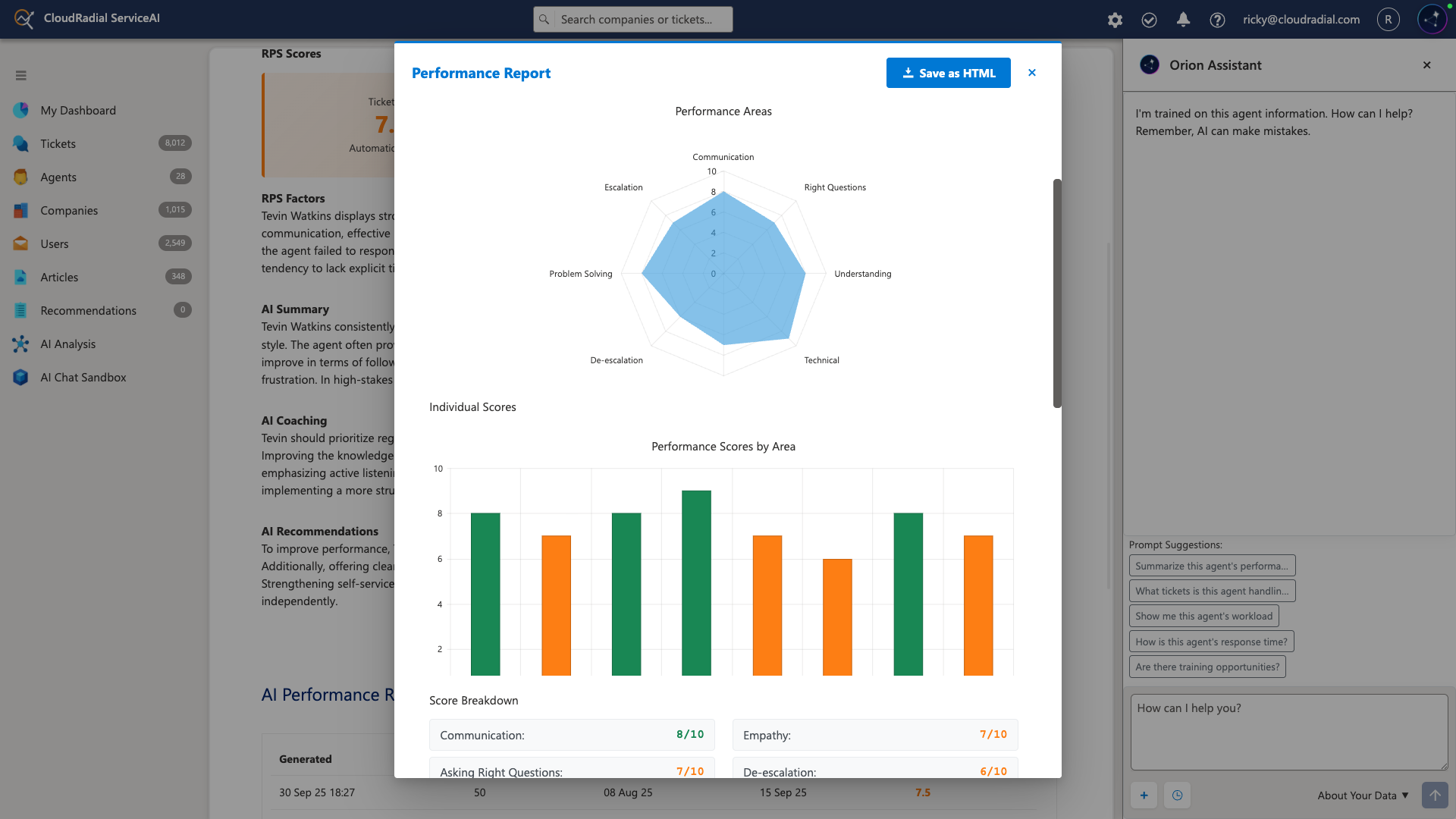
ServiceAI's Agent RPS scores measure technician performance based on communication quality, resolution patterns, and interaction quality. Use this to measure how AI assistance is helping junior techs perform closer to senior levels.
Track metrics like:
- Agent RPS score convergence between junior and senior techs over time
- How quickly new techs reach acceptable Agent RPS scores (8+) with AI assistance
- Consistency of responses across your entire team
This is scalability you're creating. You're not just resolving tickets faster—you're building a team where expertise is accessible to everyone through AI, not locked in a few senior technicians' heads.
Client Pattern Recognition: Preparing for Proactive Service
ServiceAI analyzes patterns across your entire service desk. It identifies which clients have recurring issues, which ticket types cluster by company, and where documentation gaps cause problems repeatedly.
Track how quickly you're identifying and addressing patterns. Measure how many recurring issues you eliminate through better documentation or process changes.
While ServiceAI can't prevent tickets today, you're building the intelligence foundation that will enable proactive service delivery when integrated with client-facing AI tools in the future.
AI Response Quality in Sandbox: Validating Before You Deploy
ServiceAI's AI Chat Sandbox lets you test AI responses before exposing them to technicians or clients. You can see exactly how AI would respond to specific scenarios, identify gaps in your knowledge base, and refine responses until they're reliable.
Measure:
- What percentage of sandbox tests produce responses you'd confidently use?
- How many documentation gaps are you discovering and filling through sandbox testing?
- How consistent are AI responses for company-specific scenarios?
This is validation you're building before you commit to client-facing AI deployment. MSPs who rush into AI without testing fail. MSPs who battle-test responses in the sandbox prepare for successful transformation.
The Competitive Advantage Gap
Here's where transformation readiness metrics reveal something productivity metrics hide: you're not just competing against today's competitors, you're competing against what your competitors will become in 12-18 months when client-facing AI becomes standard.
Two MSPs implement ServiceAI on the same day.
MSP A measures productivity. They track time savings and efficiency gains using AI-suggested responses. They see techs resolving tickets faster. They're pleased. They report improvements to leadership. They stop optimizing.
MSP B measures transformation readiness. They track Ticket RPS trends to identify automation candidates. They measure Article RPS and systematically improve documentation. They use the sandbox to validate AI quality. They prepare their knowledge base, their processes, and their team for client-facing AI deployment when they're ready.
Twelve months later, MSP A is still doing the same work faster. MSP B has built the foundation for transformation—high RPS scores across ticket categories, comprehensive AI-ready documentation, validated response quality, and a team trained to work alongside AI.
When both MSPs are ready to deploy client-facing AI capabilities, MSP B implements successfully in weeks. MSP A discovers they need 6-12 months of preparation work first. The gap compounds from there.
How ServiceAI Enables Transformation Readiness Metrics
You can't measure transformation readiness without visibility into what transformation requires. ServiceAI provides that visibility today, preparing you for the AI-powered service delivery of tomorrow.
ServiceAI analyzes every interaction across your entire service desk. Not surveys. Not samples. Complete data. It identifies which tickets could eventually be automated. It detects documentation gaps that need filling. It tracks technician performance consistency.
The RPS scoring system shows you exactly where you stand:
- Ticket RPS reveals automation potential
- Agent RPS measures team performance consistency
- User RPS identifies client communication patterns
- Article RPS assesses documentation readiness
The AI Chat Sandbox validates quality before deployment. You can test responses, identify gaps, and refine AI behavior in a safe environment—building confidence that when you're ready to deploy client-facing AI, it will work reliably.
ServiceAI is designed to eventually integrate with CloudRadial's ChatAI (client-facing AI chat) and Unified Client Portal, creating a complete intelligent service delivery platform. But you don't need to wait for that integration to start building your transformation foundation today.
Building Your Transformation Readiness Measurement Framework
Ready to shift from productivity to transformation readiness metrics? Here's your implementation framework:
Phase 1: Analyze (Weeks 1-4)
Connect PSA, import documentation, let ServiceAI analyze historical data.
Measure:
- Baseline RPS scores across all four types
- Documentation coverage for common ticket types
- Performance gaps between team members
- Which ticket categories have transformation potential (high Ticket RPS)
Timeline: Immediate on first sync. Back-syncing provides deeper historical context.
Phase 2: Prepare (Weeks 5-8)
Improve documentation, test AI responses in sandbox, refine AI behavior.
Activities:
- Generate articles from low-RPS tickets
- Test responses in AI Chat Sandbox
- Configure custom rules for company-specific scenarios
- Set up Triage in test mode to validate routing logic
Measure:
- Rising RPS scores week-over-week
- Sandbox test success rates improving
- Documentation gaps being systematically filled
- Response consistency increasing across team
Phase 3: Deploy Internally (Weeks 9-12)
Enable Orion Assistant for technicians, activate Triage, use AI suggestions in production.
Outcomes:
- All technicians get AI assistance within PSA tickets
- Automated ticket routing and categorization via Triage
- Consistent response quality across team
- Junior techs accessing senior-level knowledge
Measure:
- Technician adoption rates (target: 80%+ using AI suggestions)
- Agent RPS scores converging across team
- Ticket RPS scores continuing to rise
- Time savings on routine ticket handling
Phase 4: Build Toward Transformation (Ongoing)
Continue improving scores, expanding AI capabilities, preparing for eventual client-facing deployment.
Measure:
- Percentage of ticket types reaching Ticket RPS 8+ (automation-ready)
- Article RPS scores for comprehensive documentation
- Sandbox validation success rates for client-facing scenarios
- Foundation readiness for future AI service delivery models
The Bottom Line: Transformation Readiness vs. Productivity
If you measure productivity, you'll optimize productivity. If you measure transformation readiness, you'll prepare for transformation.
Most MSPs fail at AI because they measure the wrong things. They celebrate productivity gains while missing the preparation opportunity.
They're like businesses in the 1990s measuring "how much faster we can send faxes" instead of preparing for email to fundamentally change business communication.
Speed matters. But building the right foundation matters more.
ServiceAI enables transformation readiness metrics that prove you're not just working faster—you're systematically building the documentation, processes, validation, and team capabilities required for true AI transformation.
The MSPs measuring transformation readiness today will be ready to deploy advanced AI capabilities when the time comes. The MSPs still celebrating productivity gains will discover they're 12-18 months behind on preparation work when client-facing AI becomes table stakes.
 CloudRadial









@2x.png)
@2x.png)
@2x.png)