Where's My Ticket? How MSPs Answer the Status Question Before Clients Ask
You know the email. "Any update on this?" Four words, and it lands in the inbox of whoever is nearest the service desk.



Enterprise-grade infrastructure with the flexibility MSPs demand

Perfectly tailored AI that knows your specific MSP

Build your own Shopify-like store with your PSA products & distributors

Have clients to submit tickets directly to your PSA, freeing up your team's time

Pre-triage and route tickets correctly with the help of AI

Everything you need to start automating, no code required.
5 min read
We wanted to skip the assumption. So instead of starting with a feature list, we looked at what's actually said, in reviews, in community discussion, and in the tickets themselves.
Three things kept showing up.
Ask any service desk manager what eats their morning and the answer is rarely "too many tickets." It's too many vague tickets. A one-line email. A forwarded voicemail transcript. A request that says "computer broken" and nothing else.
This shows up in the numbers, too. Portal forms are supposed to solve this, but they often don't: roughly one in four end users can't tell the difference between "Report a Problem" and "Request Service" when a form asks them to choose. The confusion starts before the ticket is even submitted.
It also shows up as a genuine skepticism about AI triage tools. The pattern is consistent enough to name: a vendor demos AI triage on clean, well-formed sample data, and it looks great. Then it meets a real queue, where close to half the tickets arrive as a one-line email or a fragment forwarded from a phone call, and the gap between the demo and reality becomes the story.
None of this gets fixed by adding more AI on the back end. It gets fixed at the point of contact, before a ticket exists. A structured request form with conditional logic asks the right follow-up questions instead of assuming the user knows what to say. A conversational interview, the kind an AI-assisted chat can run before a ticket is ever created, gathers the missing detail so the technician isn't the one doing the interviewing. Either way, the goal is the same: not fewer tickets, better ones. The technician's first move should be confirming a fix, not extracting a description of the actual problem.
This is the specific problem UCP's request forms and ChatAI's AI Responder are built around: structure the intake, not the aftermath.
Nearly every MSP already has a client portal. It shipped with the PSA. Almost nobody logs into it.
That's not a knock on any one platform, it's a pattern real enough that even competitors bring it up in their own marketing, citing the same community discussions MSPs have with each other about which bolt-on tools they reach for when the built-in portal isn't enough. When that's the reference point competitors use to sell against, it says something simple: MSPs already know the stock portal isn't where their clients live.
The real competition for a client portal was never the PSA's own portal. It's Outlook. If a client can email their day-to-day contact and get an answer, that's the path of least resistance, regardless of what exists elsewhere. And when the portal never gets used, the MSP's actual work becomes invisible. Compliance posture, ticket history, project progress, all of it happens, and none of it gets seen. That invisibility is exactly what makes a client start treating their MSP like a commodity: if you can't see the work, you can't tell it apart from anyone else's.
The fix isn't a better portal in the abstract. It's meeting people where they're already looking: a browser bookmark, a system tray icon, a tab inside Microsoft Teams. Somewhere that doesn't ask a client to remember a new habit.
This is the bet UCP makes: the same portal, reachable from a browser, a system tray icon, or Microsoft Teams, rather than a new destination to remember.
Client churn rarely announces itself. Nobody sends an angry email a week before they leave. More often, engagement quietly drops off (fewer questions, slower replies, less interest in the QBR) and by the time it's obvious, the decision's already been made.
This is part of why the moment a renewal conversation happens is the worst possible time to first show a client everything you've delivered that year. If the value was invisible all along, one meeting can't undo that. The fix is keeping the relationship visible continuously: a shared project roadmap the client actually looks at, a compliance posture score they can check without asking, reporting that surfaces on its own instead of getting assembled from scratch every quarter. Visibility has to be the default state, not something produced for a single meeting.
Look again at each problem, and each one already told on itself before anyone had to say a word.
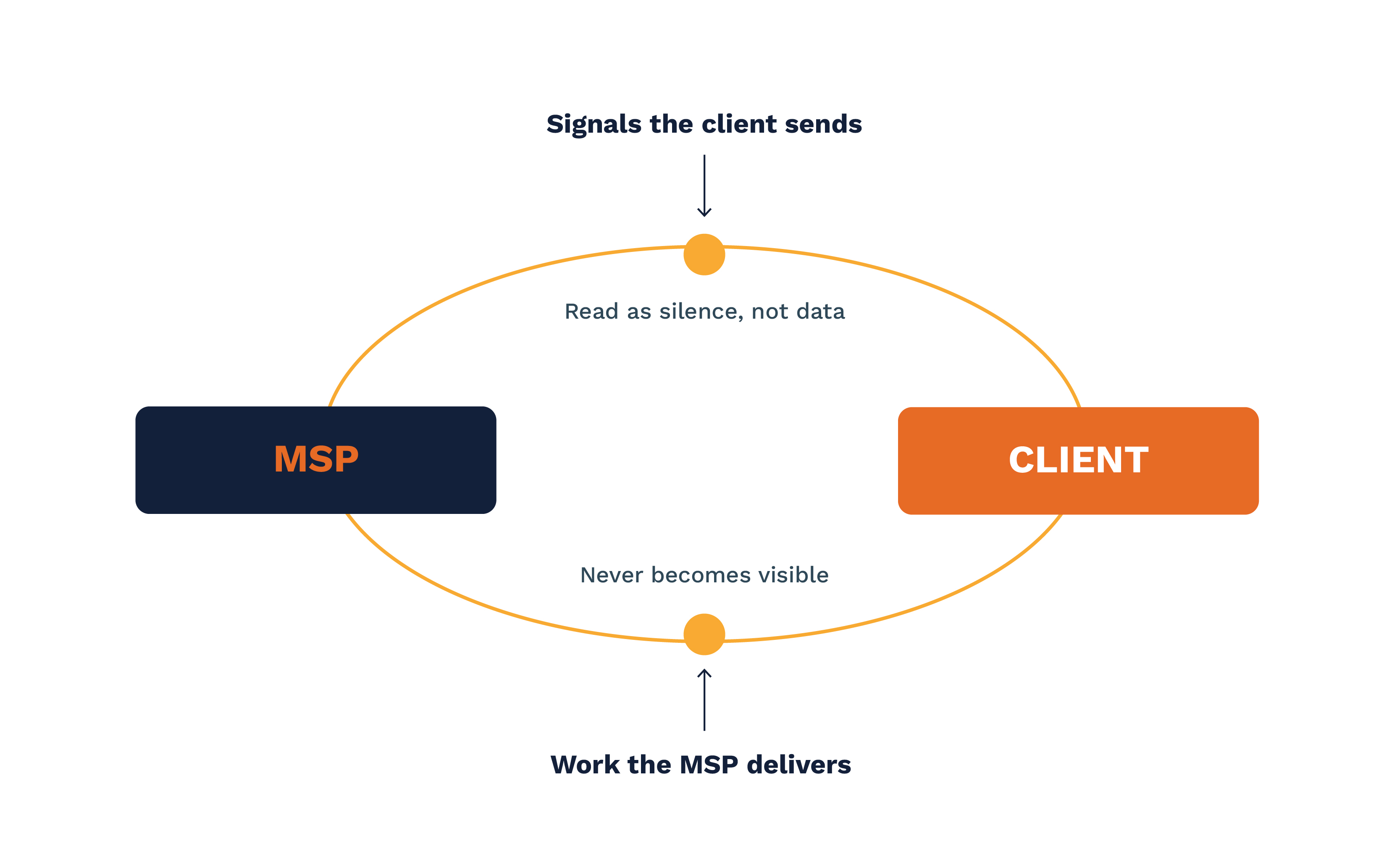
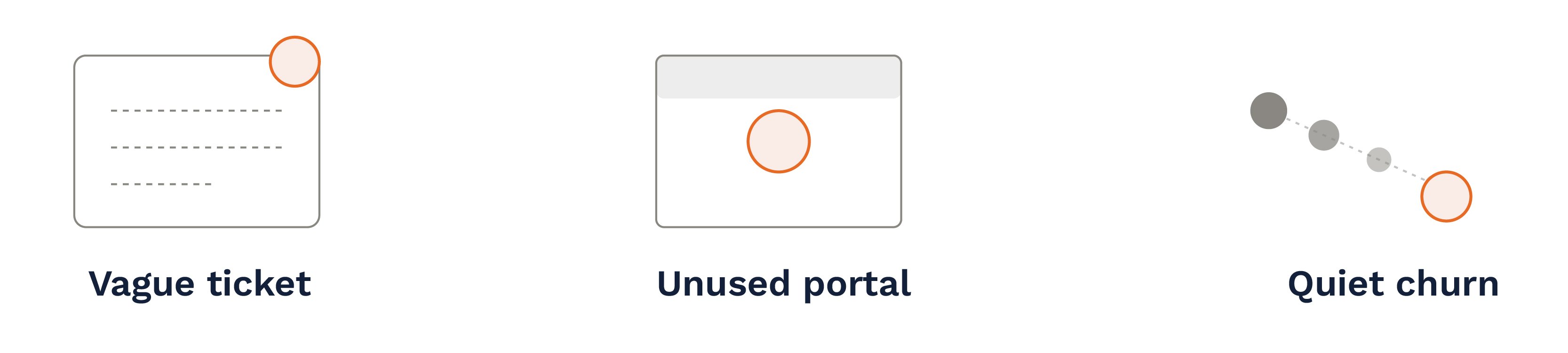
A vague ticket isn't a lack of information. It's information the intake process failed to capture, an absence standing in for a fact the technician needed and never got. An unused portal isn't a lack of engagement. It's the client sending a signal (you're not where I actually work) that never gets read as one, because nobody complained. Churn doesn't start with the accounts that leave loudly. It starts with the ones that go quiet: fewer questions, slower replies, less interest in the QBR, months before the account is actually gone.
In every case, the silence already contained the answer. The problem wasn't that nothing happened. It's that nothing was set up to notice.
That's only half of it, though. Flip the direction and the same blind spot shows up again, pointed the other way. A technician resolves an issue, compliance posture stays current, a project moves forward on schedule, and none of that work becomes visible to the person who'd actually value knowing about it. The client isn't ignoring the MSP's value. Most of the time, they simply can't see it. So there are two failures running in parallel: MSPs aren't built to detect the signals clients are already sending, and MSPs aren't built to make their own work visible back.
Both point toward the same kind of fix, and neither one is "add more AI."
Detect absence, don't wait for complaints. A ticket missing the fields a real resolution needs should get flagged before a technician ever picks it up, the same way a client's engagement quietly dropping off over a few weeks should surface as a signal worth a phone call, not a surprise six months later. The system's job is to notice what's missing, not just process what's already been said.
Make the work visible without anyone having to go looking for it. If a client has to remember to log into a portal to check their compliance posture, most of them won't. If the QBR is the first time all year anyone sees the project roadmap, of course it feels like a presentation instead of an update. Value that only exists when someone actively goes looking for it might as well not exist for the people too busy to look.
Put together, the pattern isn't "we need smarter tools." It's "we need systems built to notice what's already there on both sides of the relationship."
Why do so many support tickets arrive without enough detail to act on?
End users often don't know how to describe a technical problem in a way that maps to how a service desk categorizes work, and confusing intake forms make it worse. The fix is usually better structure at the point of contact, not more processing after the fact.
Why don't clients use the portal that came with the PSA?
Most client portals ask people to remember a new destination and a new login. Clients default to whatever's easiest, usually email, unless the portal shows up somewhere they already work.
How can an MSP catch client churn before it happens?
Look for quiet disengagement rather than complaints: fewer questions, less QBR interest, slower replies. Keeping the relationship's value visible year-round, rather than only at renewal, makes early disengagement easier to spot and address.
@2x.png)
You know the email. "Any update on this?" Four words, and it lands in the inbox of whoever is nearest the service desk.
Every MSP has a ticket that reads "new hire starting Tuesday, needs a laptop." It's not wrong. It's just not finished.
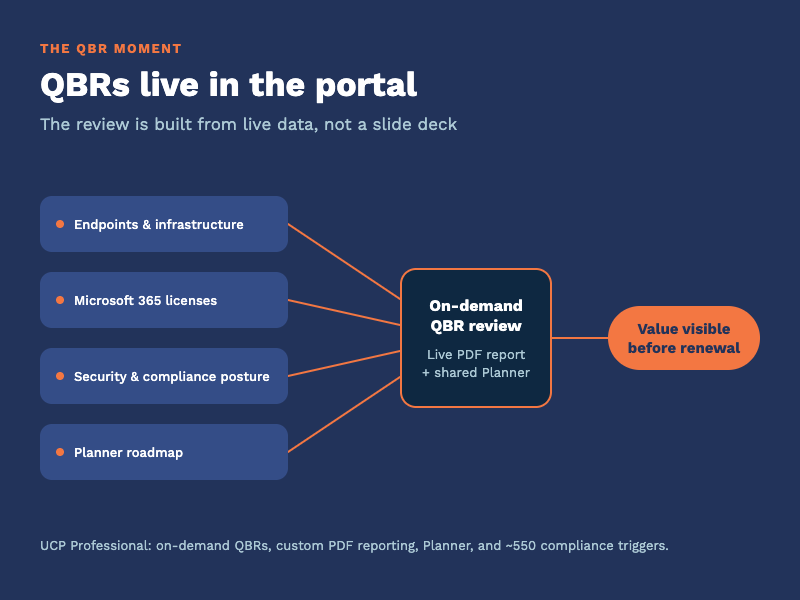
Every quarter you sit across from a client and answer one question, spoken or not: what are we paying you for? The quarterly business review is where...