 CloudRadial
CloudRadial 2025: The Year MSPs Stopped Experimenting with AI and Started Transforming
As we close out 2025, it's clear that this was CloudRadial's most transformative year yet. We didn't just release new features—we fundamentally...




Enterprise-grade infrastructure with the flexibility MSPs demand

Perfectly tailored AI that knows your specific MSP

Build your own Shopify-like store with your PSA products & distributors

Have clients to submit tickets directly to your PSA, freeing up your team's time

Pre-triage and route tickets correctly with the help of AI

Deliver instant, accurate answers that can help achieve zero-touch resolution

You've seen the headlines. AI has the power to transform IT service delivery.
Your competitors are talking about it. Your clients are asking about it. So, you start by doing what seems logical: you add a chatbot to your website or client portal.
Three months later, you're wondering why clients are frustrated, why tickets haven't decreased, and why your "AI initiative" feels like it added work instead of reducing it.
Most MSPs fail at AI because they implement pieces instead of systems. They deploy chatbots without intelligence. They build intelligence without integration. They add tools without transformation.
It's like trying to create a living organism by assembling random body parts. A mouth that can't think. A brain that can't act. A body with no intelligence to guide it.
The result? Generic responses that frustrate clients. AI that makes your team slower, not faster. Technology that impresses nobody and transforms nothing.
CloudRadial ServiceAI takes a fundamentally different approach. We're not selling you AI pieces; we're helping you build a complete AI organism where every component supports the others.
Think back to science class and those diagrams of thriving ecosystems. Each part had a role. Each part depended on the others. Remove one element, and the whole system collapsed.
That's exactly what we're building for your MSP, and it has three essential components:
ServiceAI is the intelligence center of your operation. It analyzes your historical tickets and documentation, learning from your team's expertise and processes over time.
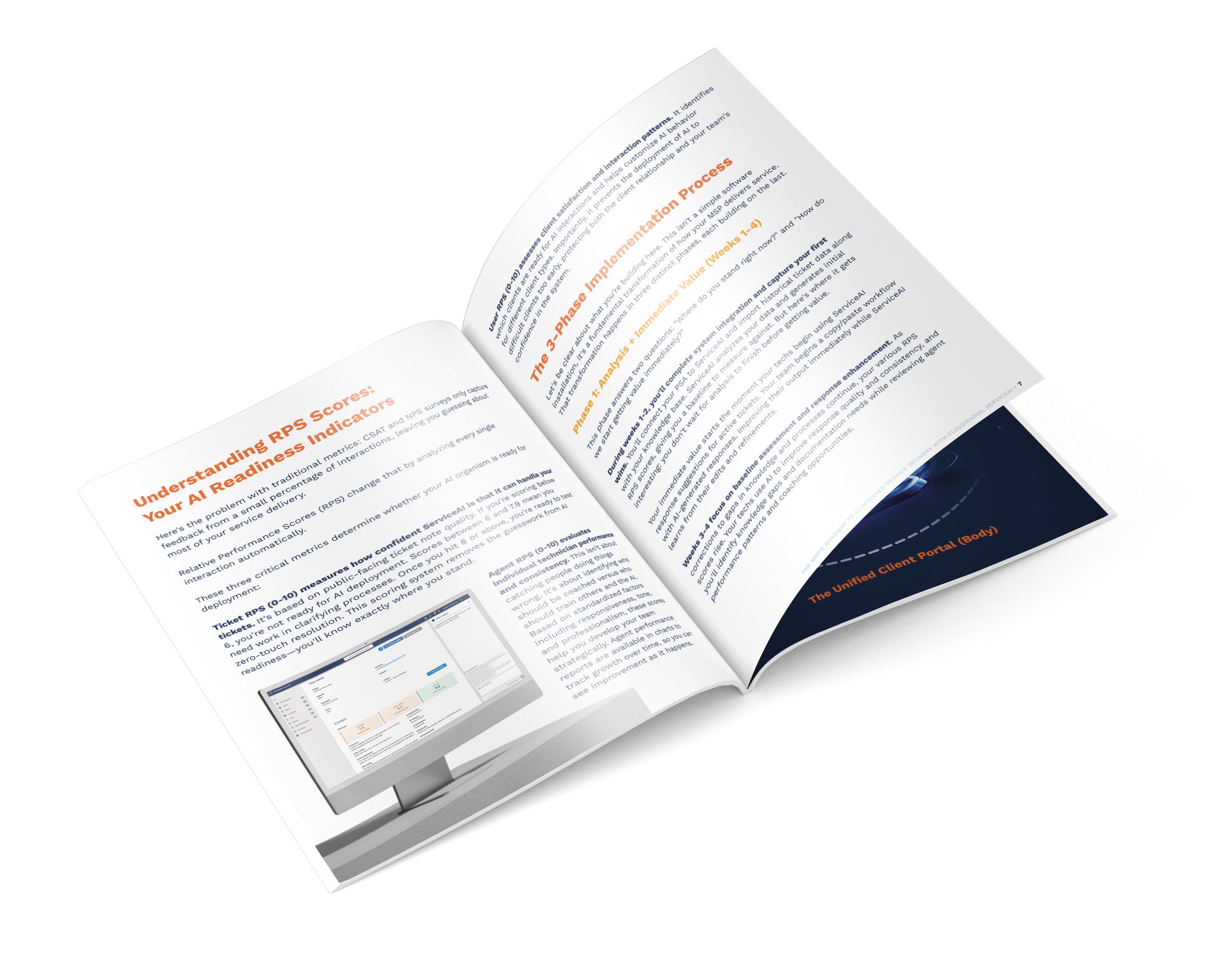
But here's what makes it different from generic AI: ServiceAI generates confidence scores that tell you exactly when you're ready for AI deployment. No guessing. No hoping. No crossing your fingers and wondering if your AI will embarrass you in front of clients.
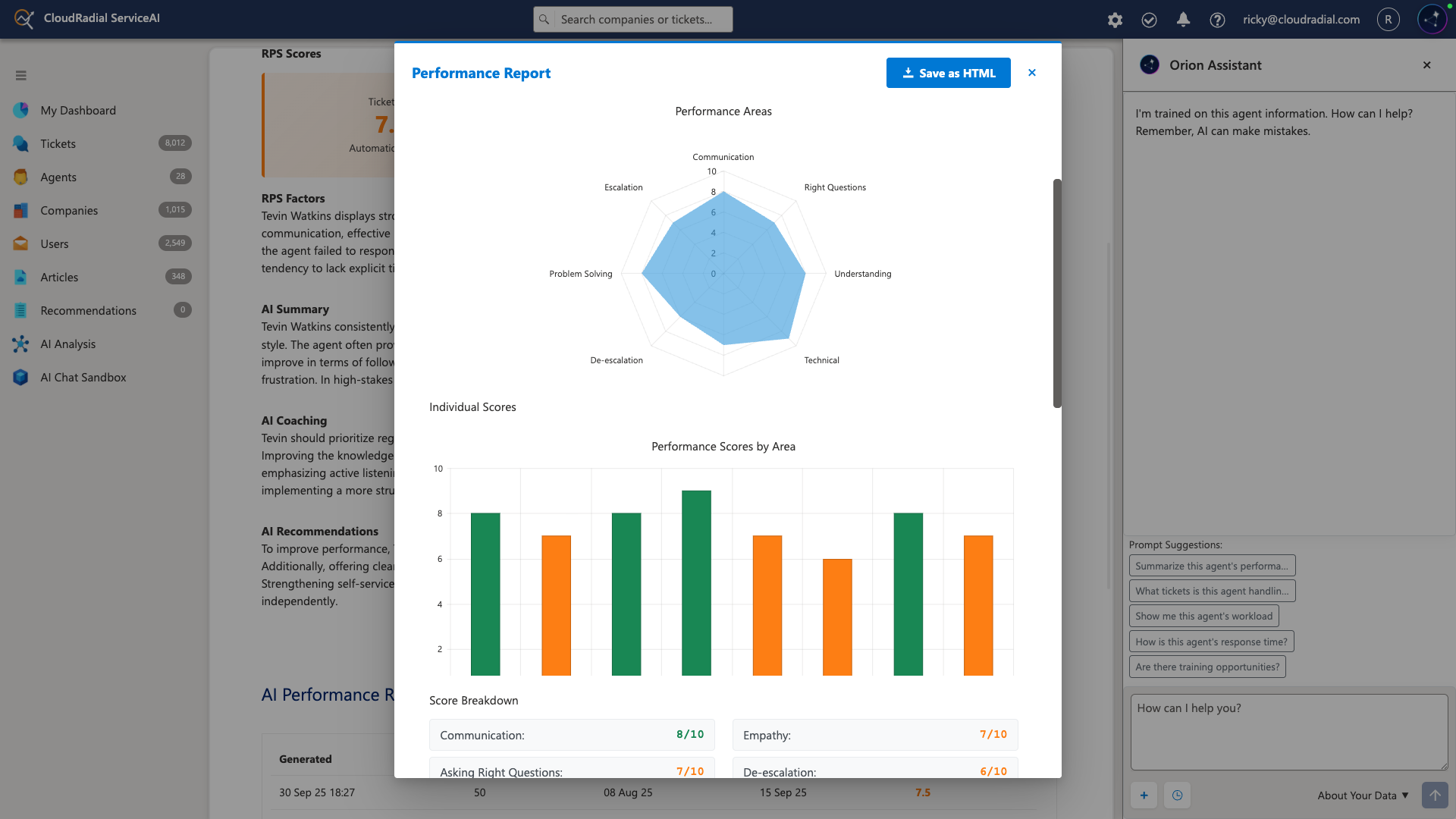
It identifies knowledge gaps and training opportunities before they become problems. It detects patterns in your service delivery that humans miss. And it delivers operational intelligence to your technicians right when they need it—not buried in a knowledge base they'll never search.
Think of ServiceAI as the expertise amplifier your team didn't know they needed. Junior techs get access to senior-level knowledge. Senior techs get freed from routine questions to focus on complex problems. Everyone gets smarter, faster.
ChatAI is how your intelligence communicates with clients. It's the interface that turns ServiceAI's brain power into client-facing conversations.
But this isn't another generic chatbot spouting pre-written scripts. ChatAI delivers expert-level responses based on your specific data: your tickets, your documentation, your way of doing things.
It has the capability for zero-touch resolution for routine issues. Password resets. "How do I..." questions. Basic troubleshooting. The stuff that clogs your service desk and prevents your techs from doing meaningful work.
And when something complex comes up? ChatAI seamlessly escalates to human technicians with full context, so your team isn't starting from scratch.
This isn't generic AI. It's your expertise, available 24/7, speaking in your voice.
The Unified Client Portal is what connects everything together and makes it accessible.
It's where all your systems and data sources integrate. It's where clients experience the complete picture of your services. It's the user interface that houses ChatAI and makes ServiceAI's intelligence visible.
Without the portal, you're trying to bolt AI onto disconnected systems. With it, you create a cohesive experience where intelligence flows naturally to everyone who needs it.
The portal enables advanced integrations and customizations that would be impossible with disconnected tools. It's not just a pretty interface; it's the connective tissue that makes the organism function as a whole.
Here's what happens when you try to cut corners:
A mouth without a brain just makes noise. Deploy ChatAI without ServiceAI, and you get a chatbot that can triage tickets or categorize requests. At best, it saves clients one click. At worst, it frustrates them with responses that sound helpful but lack substance. You'll never achieve zero-touch resolution. You'll never take real load off your team.
A brain without a body has no way to act on its intelligence. Implement ServiceAI without the Unified Client Portal, and you're building intelligence with nowhere to present it. You have no single point of reference for clients. No transparency. No way for clients to see the value you're delivering or access the smart capabilities you've built. Your AI gets smarter in the background, but your clients never experience the benefit.
A body without AI is functional but can't get smarter. Run the Unified Client Portal without ServiceAI, and you've got a nice client portal that operates independently. It works well today, but it can't learn from interactions, can't predict issues, can't get more valuable over time. You're stuck in the present while competitors build systems that improve with every ticket.
Here's what makes the complete organism so powerful: each component makes the others better.
ServiceAI learns from every ticket your team handles, getting smarter about your specific environment. That intelligence feeds ChatAI, making client interactions more accurate. ChatAI's conversations create new data that helps ServiceAI identify patterns. The Unified Client Portal connects everything, ensuring learning happens across all touchpoints.
This is the compound effect in action. Day one, your AI handles basic questions. Month three, it's resolving routine issues without human intervention. Month six, it's predicting problems before they occur and coaching junior techs to senior-level performance.
Miss one component, and you break this learning cycle. You get stuck at "slightly helpful" instead of reaching "genuinely transformative."
When the complete organism is functioning, here's what changes:
Your ticket volume drops by 40% or more, not because clients stop having issues, but because routine problems resolve instantly without tech involvement.
Your client satisfaction improves—not despite AI, but because of it. Clients get instant answers at 2 AM instead of waiting until morning. They experience consistency across all interactions instead of quality varying by which tech answers.
Your team operates at a higher level. Junior techs perform like veterans because ServiceAI gives them instant access to your best expertise. Senior techs focus on complex, interesting problems instead of answering the same password reset questions for the thousandth time.
Your competitive positioning shifts. You're not just another MSP with AI "features." You're delivering genuinely intelligent service that learns from every interaction and gets better over time.
You have two paths forward.
Path one: Keep implementing AI pieces. Add a chatbot here, try some AI-assisted documentation there, hope it all somehow comes together. Stay frustrated with results that never quite match the promises.
Path two: Build the complete AI organism. Start with ServiceAI analyzing your operations and delivering immediate value to your techs. Add ChatAI when your intelligence is ready for client-facing deployment. Connect everything through the Unified Client Portal that makes it accessible and valuable.
The MSPs implementing complete AI organisms now will have a 12-18 month learning advantage before competitors can catch up. Their systems are getting smarter every day. Their operational knowledge is compounding. Their competitive moat is widening.
The question isn't whether AI will transform MSP service delivery. The question is whether you'll lead that transformation by building it right or spend years catching up to competitors who started today.
Download our full implementation roadmap to see exactly how ServiceAI, ChatAI, and the Unified Client Portal work together to transform service delivery in 90 days.


As we close out 2025, it's clear that this was CloudRadial's most transformative year yet. We didn't just release new features—we fundamentally...
Your service desk manager pulls up the dashboard and smiles. Response times are down 35%. Tickets per technician are up 22%. Documentation time has...
Most AI implementations fail because they're treated like software installations instead of business transformations.