 CloudRadial
Co-Managed IT: How MSPs and Internal IT Teams Share One Client Experience
Co-managed IT used to be the deal you took when a prospect wouldn't let go of their in-house team. That's not where things stand now. Coverage of the...



Enterprise-grade infrastructure with the flexibility MSPs demand

Perfectly tailored AI that knows your specific MSP

Build your own Shopify-like store with your PSA products & distributors

Have clients to submit tickets directly to your PSA, freeing up your team's time

Pre-triage and route tickets correctly with the help of AI

Everything you need to start automating, no code required.
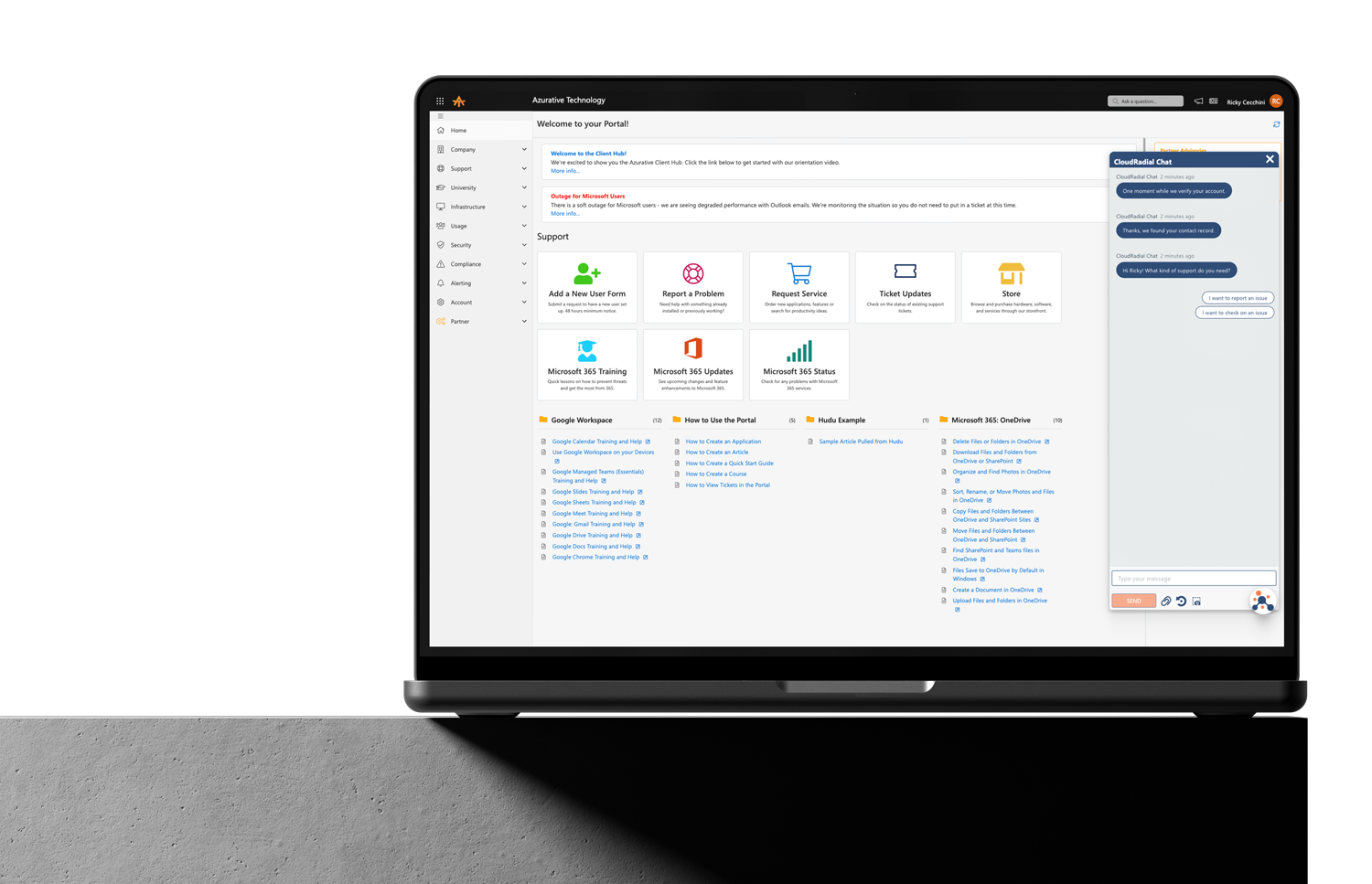
In Part 1 of this series, we looked at why standalone client portals struggle with adoption — and why the fix isn't a better portal. The underlying issue is simpler than that: clients use whatever channel requires the least effort, and for most business users today, that channel is Microsoft Teams or Slack.
In this post, we're going to look at that shift in more depth. Not as a trend to watch, but as a reality that's already happened. And we'll look at what it actually means for how MSPs deliver support.
There's a version of this conversation that still treats Microsoft Teams as "that video call app." That version is about five years out of date.
For a growing majority of SMB and mid-market businesses — the exact clients MSPs serve — Teams has become the operating system of the workday. Files live there. Conversations happen there. Projects are tracked there. New employees are onboarded through it.
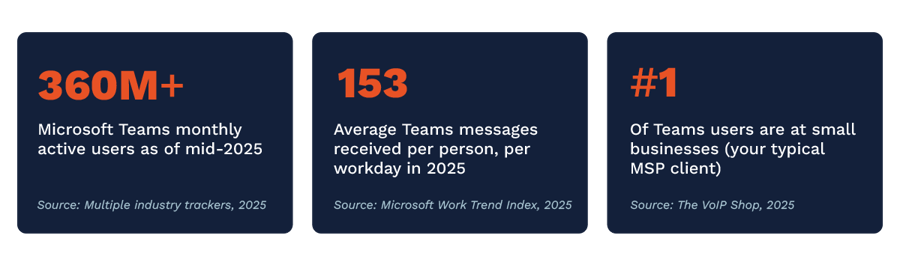
The 153 messages per person per workday figure is worth sitting with. That's not a platform people check occasionally. That's a platform people are in continuously — more than email, more than any other communication tool for millions of knowledge workers.
When a user in that environment has an IT problem, their reflex isn't to open a browser and navigate to a portal. Their reflex is to type a message. That's what their thumbs know how to do. The question for your MSP is whether that message lands somewhere you can actually act on.
Not every client is in Teams. A meaningful slice of your client base, particularly in tech, creative, and startup-adjacent industries, runs on Slack. And Slack's growth trajectory tells a similar story to Teams.
Slack reached an estimated 47 million daily active users in 2025, used across more than 750,000 organizations. The platform's Slack Connect feature — which extends workspaces across company boundaries for inter-company communication — grew 35% in 2025 alone. That growth matters for MSPs specifically, because it signals that Slack is increasingly being used not just internally but as a vendor and partner communication channel.
"If your clients primarily use Microsoft Teams for internal communication, implementing chat support directly within Teams means they never have to leave their familiar environment to get help."
The practical implication: some of your clients are already using Slack to communicate with their own vendors. The question of whether your MSP should be reachable there isn't hypothetical; it's whether you want to be on the list of vendors they message directly, or whether you want to be the one asking them to do something different.
There's a version of the multi-channel argument that's mostly marketing ("be everywhere!") and it doesn't hold up under scrutiny. Supporting every conceivable channel just because it exists creates operational chaos. That's not the argument here.
The argument here is more specific: Teams and Slack are where your clients spend the majority of their workday, and when an IT problem interrupts that workday, they're going to reach for the channel they're already in. If your support isn't accessible there, you're not failing to be modern, you're creating friction at the exact moment your client needs you most.
THE DIFFERENCE IN PRACTICE
Without Teams integration: Client's VPN drops. They open a browser, navigate to your portal URL, log in, fill in a ticket form, submit, and wait for an email confirmation. Three minutes of friction before the problem is even in your queue.
With Teams integration: client's VPN drops. They type a message in the IT support channel in the app they already have open. Ticket is created with the conversation transcript in your PSA. Thirty seconds, no context switching, no login.
The second scenario isn't hypothetical: it's what clients increasingly expect, because it mirrors how they interact with every other modern service in their business stack. The gap between that expectation and a portal-only support model is widening every year.
When MSPs have tried to offer chat support and found it didn't work, the failure usually came from one of two places: either they deployed a live chat tool that required someone to be sitting and waiting to respond (which most MSPs can't staff), or they tried an AI chatbot that was too general-purpose and frustrated clients with unhelpful responses.
Both failures come from the same mistake: treating chat as a live-staffing problem rather than an intake-and-escalation structure.
The most common reason MSPs avoid chat is: "We don't have the bandwidth to sit in a chat queue all day." This is a legitimate concern for live, unstructured chat. But it's the wrong mental model for how modern chat support works.
Structured chat intake, like a dialog-based conversation flow, handles the intake phase without requiring a live agent. It collects the information, creates the ticket, and escalates to a human only when the situation calls for it. Your agents aren't sitting in a queue; they're notified in their own Teams or Slack workspace when a conversation needs them. The same channels they're already in.
The MSPs who've seen chatbots fail usually deployed them with unrealistic expectations — expecting the bot to resolve issues independently, without guardrails, and without a clear escalation path. When the bot couldn't help, clients were left hanging with no way forward.
Well-designed chat support doesn't promise autonomous resolution. It promises structured intake, consistent documentation, and seamless escalation. The value isn't "AI solves your problem." The value is: your client's message gets into the right place with the right information attached, and a human is ready when they're needed.
The data on Teams and Slack adoption isn't a prediction about where business communication is heading. It's a description of where it already is. The SMBs you support are already spending most of their workday in these platforms. The question isn't whether to take that seriously.
The question is: when your client has an IT problem and types a message in Teams, where does it go? Does it go into a structured intake flow that creates a well-documented ticket in your PSA? Or does it go to a colleague who screenshots it and sends a separate email?
The MSPs who solve that problem aren't just improving their intake efficiency. They're changing the experience of IT support for their clients; from something that interrupts the workday into something that fits inside it.
CloudRadial Chat Starter is free, includes Teams and Slack support, and connects to your PSA from day one. Get from zero to live support in under five minutes.
@2x.png)
Co-managed IT used to be the deal you took when a prospect wouldn't let go of their in-house team. That's not where things stand now. Coverage of the...
@2x.png)
Ticket triage doesn't get much attention. It's the work between a request showing up and someone actually fixing it, and it's easy to treat as a...
@2x.png)
You know the email. "Any update on this?" Four words, and it lands in the inbox of whoever is nearest the service desk.