MSP Request Forms that Produce Complete Tickets, Not Follow-Up Emails
Every MSP has a ticket that reads "new hire starting Tuesday, needs a laptop." It's not wrong. It's just not finished.



Enterprise-grade infrastructure with the flexibility MSPs demand

Perfectly tailored AI that knows your specific MSP

Build your own Shopify-like store with your PSA products & distributors

Have clients to submit tickets directly to your PSA, freeing up your team's time

Pre-triage and route tickets correctly with the help of AI

Everything you need to start automating, no code required.
6 min read

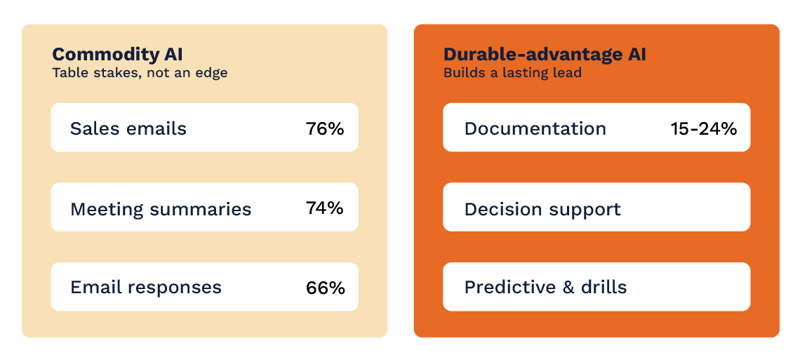
In our 2026 State of AI in the MSP Industry report, writing tasks like drafting sales emails (76%) and summarizing client meetings (74%) have crossed into the mainstream, meaning they no longer differentiate anyone.
The genuine, compounding opportunities sit elsewhere: documentation automation (just 15–24% adoption today), deeper security AI, and AI that supports technician decision-making.
Meanwhile, client demand is racing ahead of provider delivery — the 2026 Kaseya State of the MSP report found 48% of MSPs name AI and automation as their clients' top need, yet only 13% have turned it into meaningful revenue. This guide lays out exactly where the AI opportunity is concentrated for MSPs, and where spending effort is wasted.
Yes. Across our survey, fewer than 10% of MSPs said they have no plans to use AI for any of the eight business outcomes we measured: service quality, cost reduction, customer satisfaction, competitive positioning, and more. For competitive positioning specifically, fewer than 5% saw no role for AI at all.
That makes the ROI conversation effectively over. MSPs aren't treating AI primarily as a cost-cutting tool; the outcomes they're pursuing first are improving service quality (51% already using AI here) and reducing costs (46%). The risk calculation has inverted: for most providers, the risk of not investing now exceeds the risk of investing.
The external data agrees. Kaseya's 2026 report found AI and automation outranked even security as the top client need for the year. Demand is real and broad. The open question isn't participation — it's where to aim.
No. Writing AI is now table stakes, not a differentiator. In our survey, the most-adopted use cases were all output-focused, low-friction tasks:
Writing sales emails — 76%
Summarizing client meetings — 74%
Writing email responses — 66%
Generating social media posts — 59%
Filtering spam tickets — 58%
These were the natural first wave: they require no deep system integration and deliver immediate, visible time savings. Most MSPs found them, adopted them, and moved on. The implication is direct: if writing assistance is the extent of your AI deployment in 2026, you're not ahead, you're at parity with peers who implemented the same tools a year ago.
Deploy these tools, absolutely. But an MSP that leads its AI story with "we use AI to write emails and summarize meetings" is describing commodity capability. The story that builds client confidence is what comes after the writing tools.
Documentation. It's the most concentrated first-mover opportunity in our entire dataset: near-universal demand, near-zero deployment.
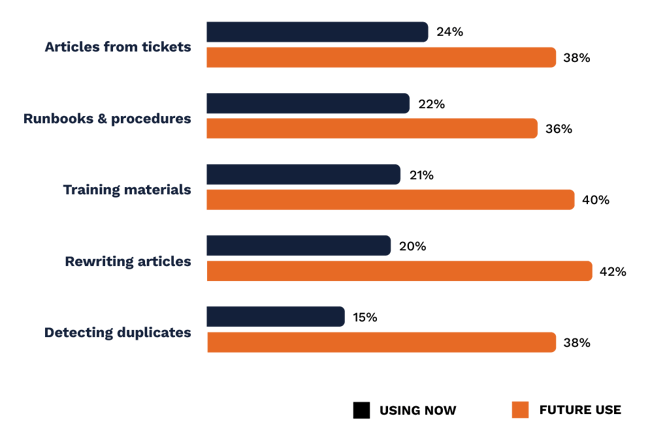
Every documentation use case we measured followed the same unusual pattern: current adoption between 15% and 24%, future intent between 36% and 42%, and low resistance. Generating knowledge base articles from resolved tickets, creating runbooks and procedures, producing training materials, rewriting stale articles: MSPs know these matter, and almost none have moved yet.
Documentation has always been the pain point every MSP acknowledges and few do well — not for lack of will, but because it required the one thing technicians never have: time. AI changes that equation. When a ticket resolves, the documentation can write itself. When a process changes, the runbook can update automatically.
The reason this rewards early movers isn't the technology, it's the accumulation. A knowledge base built over twelve months of resolved tickets, updated runbooks, and generated training materials is not something a competitor can spin up quickly. By the time they start, you're a year of institutional knowledge ahead — and that's a lead they can't simply buy.
Documentation is one of five findings we unpack in the full report. See the complete breakdown across all 47 AI use cases →
Yes, security AI has crossed from differentiator to baseline expectation. In our survey, the core security use cases are all above the 40% adoption threshold that signals a category-level tipping point:
Recommending incident responses — 53%
Detecting threats — 51%
Assessing current security policies — 44%
What's most telling is the low resistance: only 12% of MSPs have no plans for threat detection or response recommendations, compared with resistance of 25–38% in other categories. Security AI isn't being debated; it's being deployed. Kaseya's data reinforces this from the revenue side, with cybersecurity posting the strongest year-over-year growth of any service category.
The next wave is already visible. Conducting security drills sits at just 11% adoption today but carries a 48% future-intent pipeline, among the largest in the survey. MSPs built detection and response first; now they're turning to preparedness. The practical takeaway: AI-enhanced security is no longer something to advertise as special. The real question is whether your security AI practice is deep enough to stay ahead as the client baseline keeps rising.
The ones that fall outside your core competency. Resistance to AI is low overall: an average "no plans" rate of just 17%, but it isn't random. The highest resistance use cases in our survey cluster tightly:
Client churn assessments — 39% no plans
Managing client email campaigns — 37%
Creating custom AI applications — 35%
Generating client budgets — 32%
Analyzing insurance coverage — 30%
These share a thread: they require expertise MSPs typically don't carry in-house — data science, software engineering, marketing — or they touch areas where errors carry real financial consequences. The pattern is consistent enough to name plainly: MSPs deploy AI, they don't build it. Where AI arrives through existing platforms and workflows, adoption is high. Where it demands building something from scratch or operating outside your wheelhouse, it stalls, regardless of how compelling the use case looks on paper.
That's not a gap to feel guilty about closing. It's a signal about where to look: for tools that meet you where you already operate, rather than projects that turn your shop into a software company.
No, and this matters more in 2026 than it used to. Kaseya's report found that the talent gap has overtaken tooling as the MSP industry's primary operational constraint, with difficulty hiring skilled technicians jumping from 9% to 16% year over year. AI's role is to relieve that pressure, not to cut staff.
The expectations bear this out. In Kaseya's data, 59% of MSPs expect AI to eliminate tedious tasks and 44% expect it to free up time for strategic work, while only 21% expect it to reduce headcount. The operational wins are already landing where it counts: automation improved first-response times for 35% of providers, technician efficiency for 32%, and (notably, given burnout) employee satisfaction for 31%.
The honest framing for clients and staff alike: AI is how an MSP scales output without scaling headcount at the same pace. It's augmentation, not replacement. (One caveat worth owning openly: about a third of MSPs in Kaseya's survey expect AI to introduce new security risks, so the capable move is to govern AI deliberately rather than bolt it on.)
The data says yes. Fewer than 10% of MSPs in our 2026 survey have no plans to use AI for any business outcome they care about, and the leading goals are service quality and cost reduction — both of which scale down to small shops. The consensus among peers is that not investing is now the larger risk.
Begin with the mainstream, low-friction tasks: meeting summaries, email drafting, ticket triage, and spam filtering. They deliver immediate time savings and are the prerequisite for everything that follows. Once those basics are running, the higher-value moves — documentation automation and client-facing AI — are where the durable advantage is built.
The key is using AI trained on your own resolved tickets rather than generic content, so documentation becomes a byproduct of work technicians already do instead of a separate task they never get to. That's the principle behind CloudRadial's ServiceAI: it learns from your MSP's actual ticket history, surfaces proven resolutions, and generates knowledge base content automatically as tickets close — turning the industry's most-neglected opportunity into a system that compounds on its own.
No. Writing AI is commodity now, but documentation automation remains wide open — high future intent, low current adoption. The window for a compounding first-mover advantage in knowledge management is open today and won't stay open indefinitely. The MSPs that capture it are the ones building a knowledge engine now rather than waiting for the category to mature.
An AI capability only creates client value if the client can see it; a remediation detected silently in the background does nothing for retention or perceived value. The practical answer is to deliver AI through a branded, client-facing surface. That's the role of CloudRadial's Unified Client Portal and ChatAI: the portal makes AI-generated documentation, reports, and recommendations visible and actionable for clients, while ChatAI gives MSPs an AI-powered chat experience clients can use immediately — without standing up full portal infrastructure first.
It can. Roughly a third of MSPs expect AI to introduce new security risks, so AI should be deployed with clear governance, not treated as a set-and-forget fix. The upside (faster threat detection and response) is real, but it has to be managed.
These findings are a snapshot. The full 2026 State of AI in the MSP Industry report maps adoption and future intent across all 47 AI use cases so you can see exactly where the industry is today and where it's heading next, and benchmark your own roadmap against 100+ MSP peers.
Sources: CloudRadial 2026 State of AI in the MSP Industry report (CloudRadial MSP AI Adoption Survey; 47 AI use cases across 100+ MSPs). External corroboration from the 2026 Kaseya State of the MSP report (survey of 1,061 managed service providers worldwide, conducted November 2025).
Every MSP has a ticket that reads "new hire starting Tuesday, needs a laptop." It's not wrong. It's just not finished.
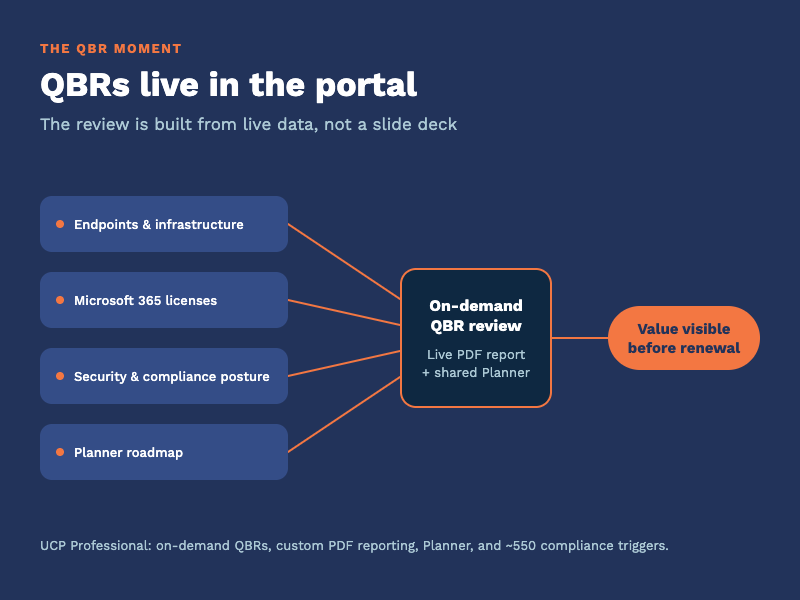
Every quarter you sit across from a client and answer one question, spoken or not: what are we paying you for? The quarterly business review is where...
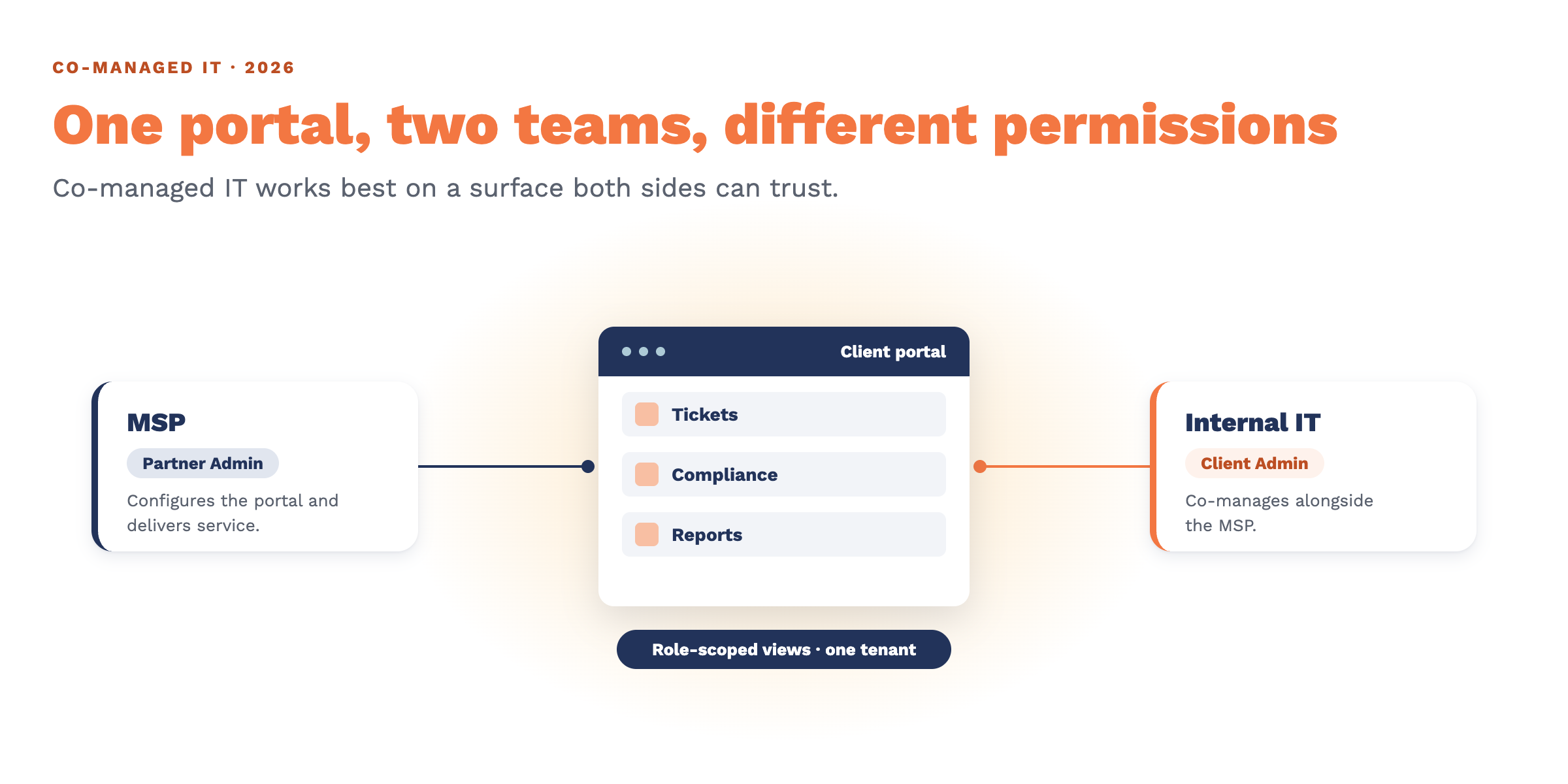
Co-managed IT is one of the fastest-growing shapes an MSP relationship can take, and it breaks a quiet assumption most service desks are built on:...